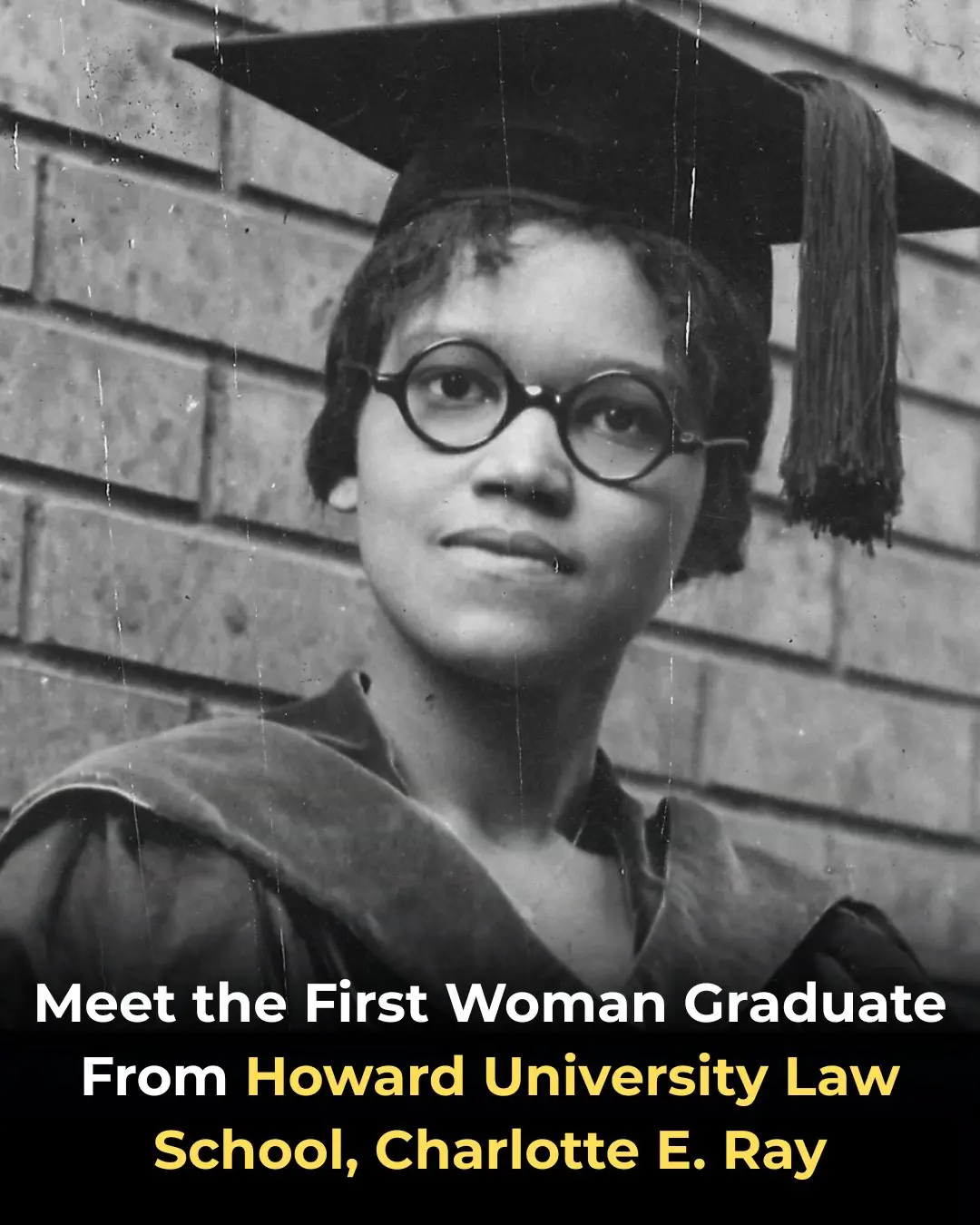
Meet the First Woman Graduate From Howard University Law School, Charlotte E. Ray
News 02/12/2025 19:57
W.E.B. Du Bois—born William Edward Burghardt Du Bois on February 23, 1868, in Great Barrington, Massachusetts—remains one of the most influential thinkers, scholars, and civil rights pioneers in American history (source: History.com). Best known for his seminal 1903 work The Souls of Black Folk, Du Bois helped shape the national conversation on race, citizenship, and inequality. His ideas laid the groundwork for future movements seeking justice and liberation for Black Americans.

As we honor six decades since his passing, it’s more important than ever to revisit Du Bois’ brilliant legacy and highlight the powerful lessons it still offers today. Here are four inspiring things you may not have learned about W.E.B. Du Bois—a man whose influence continues to guide generations.
Du Bois began his academic journey at Fisk University, an HBCU in Nashville, Tennessee. Scholarships from churches in his hometown helped fund his education, and during his time at Fisk, he served as editor of the Herald, the student newspaper. He graduated in 1888 and then continued his studies at Harvard University—also spending time at the University of Berlin in 1892 to expand his academic perspective.
In 1895, Du Bois became the first Black person in history to earn a Ph.D. from Harvard University. His groundbreaking dissertation, The Suppression of the African Slave Trade to the United States of America, 1638–1870, became his first published book and is still regarded as foundational reading for understanding the mechanisms and impact of American slavery. His academic excellence at a time of severe racial discrimination was not only historic but revolutionary.
Before sociology became recognized as a rigorous, research-based field, Du Bois was already laying the groundwork. Over the course of his career, he taught at several institutions, including Wilberforce University and the University of Pennsylvania, where he conducted one of the earliest and most comprehensive sociological studies of a Black community.
His 1899 book The Philadelphia Negro, based on empirical research and statistical analysis, challenged prevailing stereotypes and revealed how structural inequities shaped Black life. In 1897, the U.S. Bureau of Labor Statistics commissioned Du Bois to conduct studies on how slavery had affected Black families in Virginia, Alabama, and Georgia—one of the first times the federal government relied on a Black scholar for such work.
Du Bois’ approach to sociology—grounded in data, fieldwork, and firsthand observation—transformed what had previously been a mostly theoretical discipline, establishing practices that continue to shape modern social science.
Du Bois’ sharp critiques of racial inequality made him a prominent intellectual voice, often challenging other Black leaders of the time. His advocacy eventually led to his role as a founding member of the National Association for the Advancement of Colored People (NAACP) in 1909.
He served as director of publicity and research and, in 1910, launched the NAACP’s influential journal The Crisis (source: NAACP). As editor until 1934, Du Bois used the magazine to highlight racial injustice, celebrate Black achievements, and mobilize readers toward civil rights activism. By 1920, the publication had more than 100,000 subscribers, helping the NAACP become one of the most powerful organizations for Black Americans.
Under his editorial leadership, The Crisis became a central voice in the fight against segregation, lynching, and discrimination—and an essential platform for Black writers, artists, and political thinkers.
Du Bois strongly believed that the struggles of Black people in the United States were connected to those of people of African descent around the world. He coined the influential term “double consciousness”, describing the internal conflict of being both Black and American in a society steeped in racism.
He attended the first-ever Pan-African Conference in London in 1900 and later helped organize a series of Pan-African Congresses in 1919, 1921, 1923, and 1927—gathering activists, intellectuals, and leaders from the U.S., the Caribbean, and the African continent. His international work laid early foundations for future independence movements across Africa.
After rejoining the NAACP in 1944 as Director of Special Research, Du Bois attended the founding conference of the United Nations, advocating for global recognition of the oppression faced by Black Americans and urging the U.N. to help address racial injustice.
In 1961, at age 93, Du Bois moved to Ghana and accepted dual citizenship. There, he began work on a massive encyclopedia of the African diaspora, sponsored by the Ghanaian government. He passed away in Accra on August 27, 1963—just one day before the historic March on Washington led by Dr. Martin Luther King Jr.
W.E.B. Du Bois left behind a legacy that continues to shape scholarship, activism, and the global fight for racial justice. His ideas remain deeply relevant as society continues to confront issues he spent his life studying and challenging.
We honor him today because his work made our progress possible.
Because of him, we can.