The First Three Animals You See Reveals Your Dominant Trait ...
News 28/03/2026 11:36
 March 27 (Reuters) - Gold demand in India saw a slight uptick this week as softer bullion prices attracted some buyers, though many remained cautious and held off for further price drop, while premiums in China narrowed as physical demand slowed.
Bullion dealers in India offered discounts of up to $61 per ounce over official domestic gold prices this week, down from as much as $75 last week. These prices include 6% import duty and 3% sales tax.
Meanwhile, spot gold experienced volatile trading, flitting between $4,100 and $4,600 per ounce. Prices briefly touched a four-month low of $4,097.99 on Monday, pressured by a stronger dollar and growing expectations of hawkish U.S. monetary policy.
"Falling prices are helping revive interest in gold. However, prices remain well above levels seen last year, and many buyers are postponing purchases in hopes of a bigger fall," a Kolkata-based jeweller said.
Gold prices in India were trading around 141,000 rupees per 10 grams on Friday, after rising to 169,880 rupees earlier this month.
Volatility in the rupee and global prices left jewellers sidelined, with many waiting until the financial year-end to make fresh purchases, said a Mumbai-based dealer with a private bank.
In Singapore , gold was sold at prices ranging from a discount of $0.50 to premiums of $3.50 an ounce.
Singapore set out plans on Friday to turn the city state into a gold trading
hub
for the whole of Asia, with regulators and industry players working together to strengthen the market's trading, clearing and storage infrastructure.
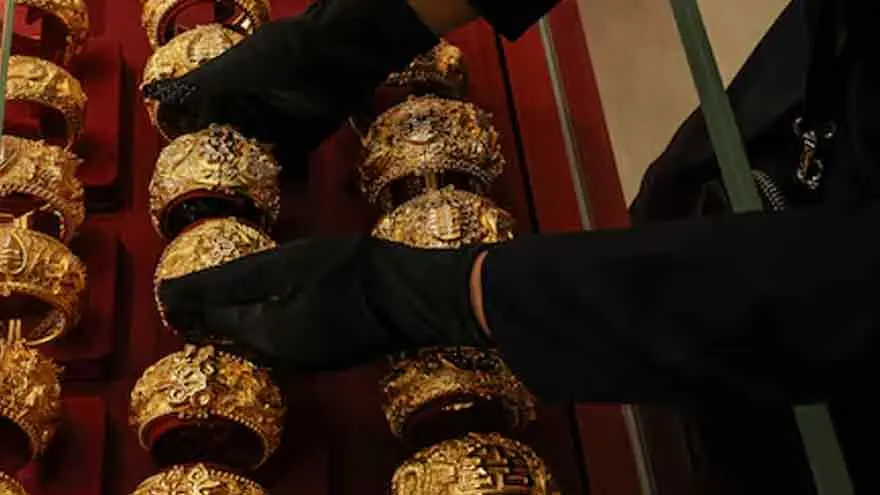
In top consumer China, bullion traded at premiums of $14-$18 an ounce over global benchmark prices this week, narrowing from a $10-$22 premium last week.
"Physical demand has cooled, reflected in lower premiums, but the market remains underpinned by central bank buying and quota restrictions," said Bernard Sin, regional director of Greater China at MKS PAMP, adding that the unresolved Middle East conflict has tarnished gold's reputation as a safe-haven asset.
"China's divergence is clear: while global headwinds weigh on gold, domestic resilience persists, sustained by policy, cultural demand, and structural supply constraints."
In Hong Kong, physical gold traded at par to premiums of $1.90, while in Japan , gold was sold at par with spot prices.
March 27 (Reuters) - Gold demand in India saw a slight uptick this week as softer bullion prices attracted some buyers, though many remained cautious and held off for further price drop, while premiums in China narrowed as physical demand slowed.
Bullion dealers in India offered discounts of up to $61 per ounce over official domestic gold prices this week, down from as much as $75 last week. These prices include 6% import duty and 3% sales tax.
Meanwhile, spot gold experienced volatile trading, flitting between $4,100 and $4,600 per ounce. Prices briefly touched a four-month low of $4,097.99 on Monday, pressured by a stronger dollar and growing expectations of hawkish U.S. monetary policy.
"Falling prices are helping revive interest in gold. However, prices remain well above levels seen last year, and many buyers are postponing purchases in hopes of a bigger fall," a Kolkata-based jeweller said.
Gold prices in India were trading around 141,000 rupees per 10 grams on Friday, after rising to 169,880 rupees earlier this month.
Volatility in the rupee and global prices left jewellers sidelined, with many waiting until the financial year-end to make fresh purchases, said a Mumbai-based dealer with a private bank.
In Singapore , gold was sold at prices ranging from a discount of $0.50 to premiums of $3.50 an ounce.
Singapore set out plans on Friday to turn the city state into a gold trading
hub
for the whole of Asia, with regulators and industry players working together to strengthen the market's trading, clearing and storage infrastructure.
In top consumer China, bullion traded at premiums of $14-$18 an ounce over global benchmark prices this week, narrowing from a $10-$22 premium last week.
"Physical demand has cooled, reflected in lower premiums, but the market remains underpinned by central bank buying and quota restrictions," said Bernard Sin, regional director of Greater China at MKS PAMP, adding that the unresolved Middle East conflict has tarnished gold's reputation as a safe-haven asset.
"China's divergence is clear: while global headwinds weigh on gold, domestic resilience persists, sustained by policy, cultural demand, and structural supply constraints."
In Hong Kong, physical gold traded at par to premiums of $1.90, while in Japan , gold was sold at par with spot prices.