The CEO who had not smiled in six years hired a new assistant, and she was the first woman brave enough to tell him he was wasting his life.
Life stories 29/06/2026 23:43
Evelyn woke to the steady sound of a heart monitor and the cold certainty that she had left evidence behind.
The ceiling above her was white. The room smelled of antiseptic and expensive flowers. When she tried to move her right hand, she realized her fingers were still wrapped around the black scrap she had taken from the boutique floor.
The blue thread remained attached to the edge.
A doctor told her she had suffered a severe blood pressure drop brought on by stress, dehydration, and not eating. No lasting damage. No reason to keep her overnight. Evelyn thanked her, but most of the words passed over her like rain against glass.
Her phone buzzed on the chair beside the bed.
Thirty-eight missed calls from board members. Eleven from Natalie Rowe, the public CEO of Aveline House and one of the few people alive who knew the full ownership structure. Dozens of messages from legal. News alerts. Screenshots. Clips.
The video had already gone viral.
It began with Graham demanding her apology and ended with Evelyn collapsing. It did not show Blair hooking her nail into the dress. It did not show the first confrontation about the forbidden garment. The captions were merciless.
Jealous wife loses it in luxury store.
Woman caught stealing faints before police arrive.
Mistress stays classy while wife causes chaos.
Evelyn scrolled once, then stopped. Shame rose in her throat, but not the kind Graham had intended. She was not ashamed of falling. She was ashamed that she had shared a life with someone who could turn a convenient lie into a sentence.
She called Graham once.
He did not answer.
Two minutes later, a text arrived.
We need to talk when you are calmer.
Evelyn stared at it until the words became meaningless. Then she took a screenshot, placed the phone facedown, and called Natalie.
“I can shut down the Madison Avenue store within the hour,” Natalie said, anger tight in her voice. “I can suspend Blair, Claire, the entire security team. I can release your name. The board wants action now.”
“No one gets fired until we know who did what,” Evelyn said.
“Evelyn, they made you kneel inside your own store.”
“Exactly. If I act like a wounded owner, the person who erased those cameras will erase everything else.”
Natalie went silent.
“The server interruption was manual,” she said finally. “Not a system failure. Someone with supervisory access shut down recording at 3:10. Seven minutes later, it resumed.”
“How many people had that access?”
“Claire, the security chief, Blair, and one outside systems contractor.”
“Keep Blair’s access active.”
“That is dangerous.”
“It is bait.”
Evelyn left the clinic through a side exit and took a cab instead of the company car waiting out front. She ate half a dry bagel from the hospital café and watched Manhattan blur by, gray and indifferent.
By early evening, she was back at the Madison Avenue boutique.
The window display had already changed. The black gown was gone.
Two guards stood near the entrance. One recognized her and hesitated. The other lifted a hand.
“Ma’am, you can’t come in. Management instruction.”
Evelyn held up her phone. “I was accused of theft in this establishment. I have the right to request a copy of the internal incident report and to know whether the police were contacted.”
Claire appeared behind them, looking as if she had aged five years in five hours. “Let her in.”
In a private client room, Evelyn found a report already filled out. It claimed she had attempted to remove an item from Blair’s purse and damaged a garment during an emotional confrontation. The witness line held the name of Mia Alvarez, a new associate Evelyn remembered only because the girl had looked terrified during the scene.
“Mia saw this?” Evelyn asked.
Claire rubbed her hands together.
“Did she see it,” Evelyn repeated, “or was she told to say she did?”
Claire’s silence answered first.
“Blair said any employee who refused to cooperate could be held responsible for the cost of the gown,” Claire admitted. “Mia supports her mother and younger brother. She panicked.”
“Bring her in. Alone.”
Mia entered with red eyes and trembling hands. She was twenty-two, wearing the black Aveline uniform with the desperate neatness of someone who could not afford mistakes.
“I didn’t see you touch the purse,” Mia said before she sat down. “I was near the register when Ms. Whitmore screamed. Afterward, she told me there was footage proving it. She said if I didn’t confirm her statement, I would look like an accomplice.”
Evelyn slid the report across the table. “You signed because you believed the video existed?”
“I signed because Mr. Harlan from security told me I could lose my job.” Mia swallowed. “But I saw something before that.”
Evelyn waited.
“Ms. Whitmore went into the fitting room with the dress and a small pair of scissors. I thought she was cutting a tag.”
The room became very still.
“Did you tell anyone?”
“Ms. Bennett. Then Mr. Prescott pulled me aside and told me not to invent details to protect a thief.”
Evelyn felt the word land, but she did not flinch. “Do not delete messages. Do not sign anything else. Forward every communication you receive to the legal contact Claire gives you.”
Mia nodded, unaware she had just taken orders from the founder of the company.
In the security room, Evelyn found a rebooted server, a nervous technician, and a report too simple to be true. The security chief, Owen Harlan, insisted the seven-minute interruption had been caused by an automatic update.
Evelyn pointed to the access log. “Why would an automatic update require Blair Whitmore’s supervisor credential?”
Owen looked away.
“Your credential confirmed the shutdown two minutes after hers,” Evelyn said.
His head snapped back. “How does a customer know that?”
“Maybe an accused customer cares more about the truth than the man hired to protect the store.”
Claire asked Owen to step out. Once the door closed, she confessed that Blair had requested temporary access to record a surprise promotional clip. Owen approved it without a formal request because Blair promised to recommend him for a regional position.
“She knew exactly which corridor would go dark,” Evelyn said. “That means the scene was planned before I arrived.”
Claire frowned. “But how could she know you were coming?”
Evelyn did not answer.
Only three people knew about her unannounced inspection. Natalie. The operations director, Victor Hale. And an assistant who had compiled the inventory report.
Graham arrived just after eight. He entered through the side door, his tie loosened, his face arranged into concern that arrived too late.
“You left the hospital without telling me,” he said.
“You never asked if I was all right.”
“I heard it wasn’t serious. Blair told me.”
The answer came so easily that Evelyn almost admired the cruelty of it.
“Blair knew before you spoke to me.”
Graham realized his mistake, then chose irritation. “We are not doing this here. You have caused enough damage.”
“I caused damage?”
“You confronted Blair. You made a private matter public. The video is hurting all of us.”
“All of us means your business.”
He lowered his voice. “My consulting firm is days away from the biggest deal we have ever had. Aveline House hired us for a strategic valuation. Any reputational disaster could ruin months of work.”
Evelyn already knew Graham’s firm had been circling Aveline’s finances. She had not known he believed Aveline had hired him directly.
“Who brought you in?” she asked.
He hesitated. “Blair made the introduction.”
“Of course she did.”
“Stop treating her like a criminal because you’re jealous.”
“She shut down the cameras.”
“You don’t have proof.”
“I have the access record.”
He looked at the screen, then at Claire, who stood silently near the wall.
“That can be explained.”
“Everything can be explained when the explanation protects what you want to believe.”
For the first time since the boutique scene, doubt crossed Graham’s face. Evelyn saw it and hated that part of her still wanted it to matter. But pride held him upright.
“Even if she accessed the system, it doesn’t prove she tore the dress,” he said. “And it doesn’t explain why you knew so much about it.”
Evelyn kept her voice steady. “I worked in textile restoration for years. I know an archive garment when I see one.”
“You never told me about that dress.”
“There are many things about me you never wanted to know.”
His eyes dropped, then hardened again. “Blair is willing not to press charges if you sign a retraction.”
“So she is afraid of a formal investigation.”
“She’s trying to avoid a disaster.”
“She’s trying to control the story.”
Later, when Graham left to take a call, Dorothy approached Evelyn near the fitting rooms and slipped a small paper envelope into her hand. Inside lay another piece of black lining.
“I found it under the bench after they took you away,” Dorothy said. “I kept it because I recognized your mother’s stitching.”
Evelyn’s throat tightened. “Who removed the dress from the archive?”
Dorothy glanced toward the cameras before answering. “A man from conservation came last night. Gray internal jacket. Said he had authorization from corporate. I didn’t recognize him.”
Evelyn showed her the blue thread.
Dorothy nodded. “Only two people at headquarters use that thread.”
By ten-thirty, Evelyn was back in the apartment she shared with Graham. He was not home. On the dining table lay a leather folder bearing a discreet Aveline House logo.
She did not intend to search his work.
Then she saw the title page.
Projected Vulnerability and Capital Entry Strategy.
She opened it.
The report described declining sales, reputational risk, and the urgent need for outside capital. Some numbers were historical. Others were confidential projections not scheduled for board review until the following week.
Blair had not merely brought Graham into a deal. She had fed him restricted data.
Evelyn photographed the pages and went to the small home office. On an encrypted terminal, she accessed the archive logs for the black gown. The system showed authorization issued in her name.
Someone had copied her digital signature.
She moved into the conservation folder. Before she could download the records, the screen flashed red.
External session detected.
Someone was watching her movements in real time.
Across the city, Blair sat inside a black car across from Graham’s building, tablet balanced on her knees. She could not see Evelyn’s name attached to the master credential, but she saw the connection source.
Graham’s apartment.
Blair looked up at the lit window on the twelfth floor.
At last, she understood that Evelyn Prescott was not just a jealous wife.
She had access to the core of Aveline House.
Part 3
By morning, the crisis had become profitable for everyone except the truth.
A second clip appeared online. It showed Evelyn passing near Blair’s open purse, framed tightly enough to suggest guilt and late enough to hide what had happened before. There was no sound. The caption claimed internal footage confirmed attempted theft.
Aveline’s online sales fell twenty-three percent before lunch.
Three influencers canceled launch appearances. A morning show requested Blair for an interview about workplace violence and “unhinged spouses.” A digital magazine published a profile of Evelyn describing her as a failed textile restorer and financially dependent wife.
The personal details could only have come from Graham.
He knew only the version of her past she had allowed him to see. Still, someone had used those fragments to build a character the internet would love to hate: poor, jealous, unstable, desperate.
At headquarters, Natalie gathered the senior team in a glass-walled conference room overlooking Midtown. Victor Hale, operations director, sat near the far end with his hands folded too neatly.
“The board wants you to appear publicly,” Natalie told Evelyn. “Not as victim. As controlling owner.”
“If I reveal myself before we trace the data leak, everyone involved will reorganize.”
Victor leaned forward. “If you stay hidden, there may be no company left to protect. The brand is being associated with a violent woman and a complicit staff.”
“Interesting word,” Evelyn said.
“What word?”
“Complicit.”
Victor’s index finger tapped the table once, twice. Evelyn had noticed years ago that he did that when he lied.
Natalie placed a forensic report on the screen. The second video had been exported from a remote terminal using a credential connected to Blair’s department. It passed through two intermediate servers but left one clean mark: the first transfer touched the network of Prescott Advisory Group.
Graham’s firm.
Evelyn read the line twice.
Graham might not have edited the video, but his company had served as the bridge.
“There’s more,” Natalie said. “Aveline never formally hired Prescott Advisory.”
“Then who did?”
“Horizon Crest Capital. They presented themselves as a potential strategic partner. We authorized only a limited review of public data. Graham’s report contains margins, stock movement, future projections, and confidential contract terms.”
Someone inside Aveline had been feeding him what he had no right to possess.
Evelyn closed the folder. “Suspend every outside access except Blair’s.”
Victor sat up. “That is reckless.”
“No,” Evelyn said. “It is necessary. I want to know what she still intends to steal.”
That afternoon, Blair appeared in a livestream wearing soft gray and a face arranged for sympathy. She said she did not want to attack Evelyn. She said she understood how painful insecurity could be for a wife. She said she was choosing compassion by not pressing criminal charges.
Then she lifted the torn black gown and announced it would be donated to an exhibit about violence against women after restoration.
Evelyn watched from her office until Blair raised the fabric.
The dress was wrong.
The embroidery was reversed. The third silver leaf had been remade in haste. Blair was displaying a replica.
The real gown was somewhere else.
At five, Graham arrived at headquarters without knowing Evelyn was in the building. Victor escorted him into a smaller conference room. Evelyn watched through an internal feed authorized by Natalie.
Graham looked tense but not outraged. Blair sat beside him, her hand too near his.
“The sales decline confirms Aveline is more vulnerable than expected,” Graham said, turning a page. “Horizon Crest can use the instability to justify a discounted capital entry.”
“How long should we wait?” Victor asked.
“Forty-eight hours,” Blair said. “Long enough for public pressure to peak.”
Graham’s mouth tightened. “I don’t want Evelyn dragged further than necessary.”
Blair touched his sleeve. “She dragged herself.”
He did not agree. He did not defend Evelyn either.
For Evelyn, that hesitation hurt more than certainty. Graham was beginning to suspect Blair, but he remained seated because the deal promised to save him.
When Evelyn left the monitoring room, she found Graham waiting near the elevator. He froze when she stepped out of the restricted hall.
“What are you doing here?”
“Working.”
“You don’t work for Aveline House.”
Evelyn pressed the lobby button. “Are you sure?”
He stepped into the elevator with her before the doors closed. “Stop playing games. Blair is trying to contain the situation, and you keep showing up where you don’t belong.”
“Blair leaked stolen internal footage.”
“You cannot prove that.”
“I can prove the file passed through your servers.”
His face drained. “That’s impossible.”
“Then investigate.”
“My team receives material from multiple sources. I don’t control every file.”
“But you signed the reports.”
“What reports?”
“The ones valuing Aveline down before official numbers were even consolidated.”
The elevator shuddered and stopped between floors for a few seconds. In that suspended silence, the last of their masks fell.
“My firm is drowning,” Graham whispered. “If this deal fails, I lose everything.”
“So that’s why you humiliated me.”
“I didn’t know the video would be released.”
“But you knew Blair was feeding you information.”
“She said Horizon had authorization.”
“You believed her because you needed to.”
He closed his eyes. “I made a mistake in that store.”
“No,” Evelyn said. “You made a choice.”
“I was under pressure.”
“I was on the floor.”
The doors opened.
Graham caught the edge before she stepped out. “Sign the separation without turning this into a public war. I’ll make sure you’re financially protected.”
Evelyn stared at him.
He still thought he was offering safety. He still did not know the elevator, the contract, the company, the building around him, all existed under the authority of the woman he was trying to reduce to a settlement.
That night, the board met in emergency session. Two outside investors pushed for immediate consideration of Horizon Crest Capital. Three directors demanded Blair’s suspension. Victor argued that revealing Evelyn as the secret owner would look desperate.
“The controlling shareholder being the same woman accused of attacking an executive creates a governance nightmare,” he said.
Evelyn watched his finger tapping the table.
“How do you know I was formally accused?” she asked.
“It’s everywhere.”
“The articles say suspected. You used the language of the internal incident report.”
Victor’s finger stopped.
Before anyone could speak, Evelyn connected a file to the main screen. A chain of transfers appeared between a conservation vendor, Horizon Crest Capital, and an account linked to Victor’s brother.
Victor stood. “This is absurd.”
“Maybe,” Evelyn said. “But it explains how my signature authorized the removal of the dress.”
Then her phone buzzed.
A message from Mia.
No text. Just a forty-three-second audio file.
Evelyn put in one earbud. Blair’s voice filled her ear, crisp and cold, ordering Mia to confirm the theft accusation. In the background, a man said the cameras would be down for seven minutes, not one second longer.
Not Graham.
Victor.
While the board erupted, an alert flashed on Evelyn’s phone.
Archive access detected.
Blair Whitmore credential active.
Evelyn left without explanation. She took the service elevator down to the climate-controlled archive and opened the door with her master key. The room was dark except for emergency lights. Cedar, silk, and old paper scented the air.
At the last conservation table, Blair stood wearing gloves and holding a bottle of solvent over the true black gown. The silver memory strip lay connected to a small reader beside it.
Evelyn closed the door.
The click echoed.
Blair spun around. For the first time, her elegance cracked. “You shouldn’t be here.”
“That sentence has been said too often inside my own company.”
Blair looked at the key in Evelyn’s hand, then at the gown. Understanding spread slowly across her face.
“Who are you?”
“The woman you tried to turn into a thief,” Evelyn said. “The woman whose husband you used to access confidential reports. And the only person who can enter this archive without asking permission.”
Blair squeezed the solvent bottle. “Don’t come closer.”
“You can ruin the dress,” Evelyn said, bluffing because she did not yet know how much of the strip had been copied. “But you cannot erase what has already been saved.”
Blair hesitated.
That was enough.
Evelyn reached for the emergency panel and flooded the archive with light. Hidden patrimonial cameras activated in the ceiling, independent of the commercial security system Blair had learned to manipulate.
Blair looked up. The red recording lights destroyed the last calm line of her face.
Evelyn spoke her full name for the first time in Blair’s presence.
“Evelyn Marianne Carter, founder and majority owner of Aveline House. Put the solvent down and tell me who else is involved.”
Blair stared at her. “You let me humiliate you just to set a trap?”
“I let you believe you had won because I needed to know the size of your fraud.”
“And your husband?”
“That was his choice.”
Blair gave a bitter laugh and set the solvent down. “Then you know he signed everything.”
“I know he accepted confidential information because he needed money and prestige. That does not make him innocent. It makes him useful to people like you.”
Security and legal arrived within minutes. Blair did not run. She sat at the table and folded her arms as if posture could still save her.
When an investigator reached for the silver strip, Blair snapped, “Careful. Remove it wrong and you erase the data.”
Evelyn looked at her. “So you know exactly what it contains.”
Blair’s eyes flashed. “Your mother was brilliant and naive. She created systems to protect designs and trusted people who never deserved trust.”
“You knew my mother?”
“My mother sewed for her. For all of you. She got paid by the piece while owners turned her hands into a fortune.”
“Marianne was paid by the piece too when she began,” Evelyn said. “She was not born owning anything.”
“That’s what your archives say.”
There was real pain in Blair’s voice. Evelyn heard it, and that made the truth more tragic. Blair’s mother might have felt forgotten even if she had been paid. A contract did not guarantee recognition. Money did not erase humiliation.
But pain did not give anyone the right to weaponize another woman.
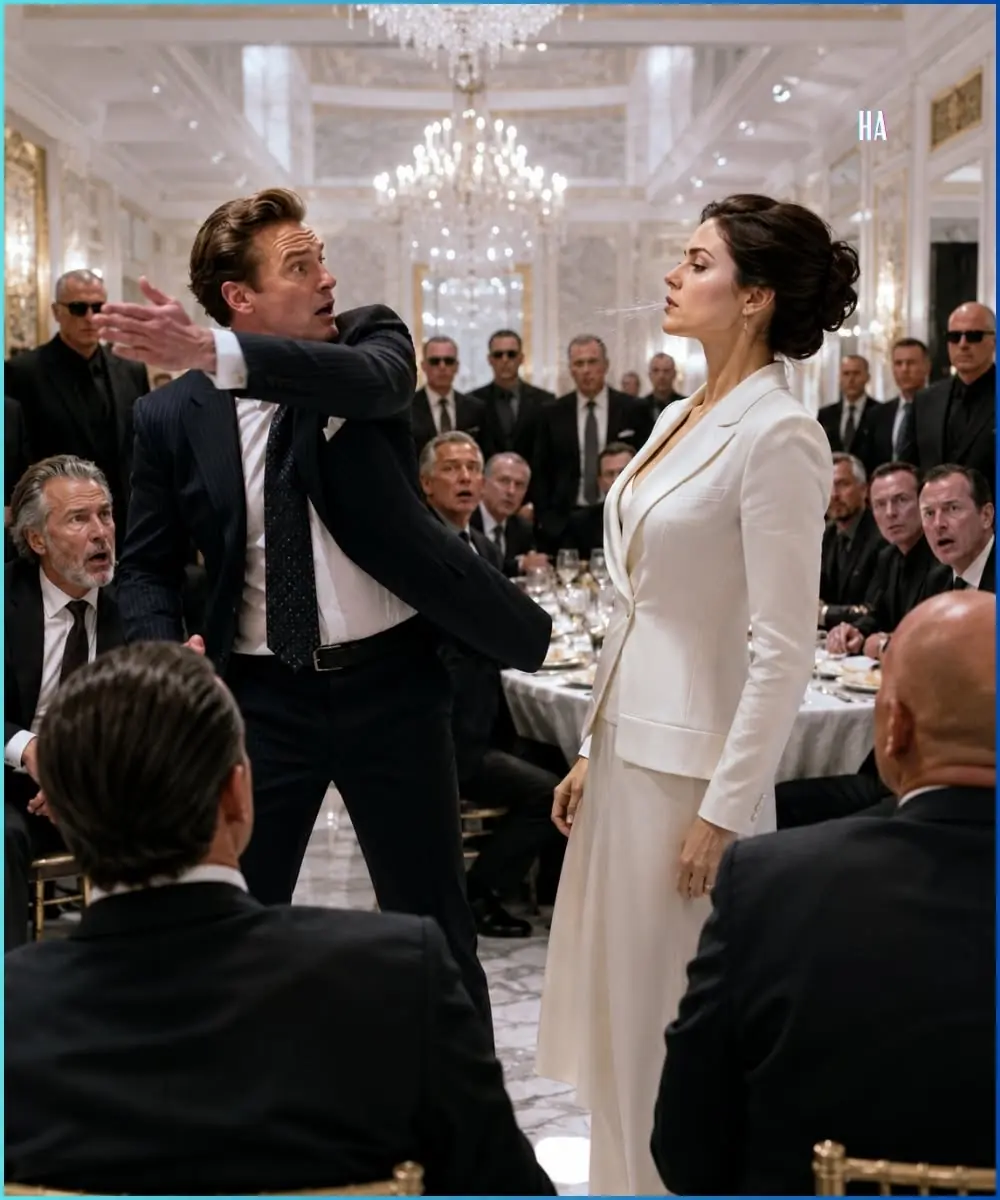
The next morning, the Madison Avenue boutique was closed to the public. Chairs filled the salon where Evelyn had fallen. Employees stood along the sides. Board members, attorneys, representatives from Horizon Crest, and selected media teams waited under strict instruction to record the entire meeting without cuts.
Graham arrived in the same tailored confidence he had worn during Evelyn’s humiliation, but he looked smaller inside it. When he tried to approach her, a guard directed him to the seats for outside consultants.
“Evelyn, please,” he said. “We need to talk before this.”
She did not raise her voice. “You had eleven years to talk. Now you will listen.”
Blair entered with her attorney. She was not handcuffed. Evelyn had refused a spectacle of force. Still, the silence that followed Blair across the marble was heavier than public shame.
Natalie began by presenting the ownership documents of Aveline House. On the screen appeared Evelyn Marianne Carter, followed by the majority stake she had controlled through a private structure for years.
A murmur moved through the room.
Claire covered her mouth. Mia stared. Graham went utterly still.
Evelyn stepped onto the same platform where Blair had posed in the stolen gown. She wore no diamonds, no dramatic suit, no symbol of wealth. Only the beige coat she had worn the day everyone believed she was powerless.
“My name is Evelyn Carter,” she began. “I founded Aveline House with my mother in a rented workroom in Queens. We had three sewing machines, one cutting table, and no guarantee we could pay next month’s rent. For years, I kept my identity away from the public image of this company to protect the work, the employees, and the independence of the brand. That silence was meant to be a shield. It became a gap.”
She looked at the employees first.
“Four days ago, I was accused of stealing inside a store that belongs to this company. My husband chose another woman’s word over mine and demanded that I kneel. I am not here to make anyone kneel back. I am here to present facts.”
The screen changed.
The history of the black gown appeared: Marianne Carter’s original sketch, the archive code, the forbidden status, the silver memory strip. Natalie explained that the strip stored encrypted design records. Overnight, forensic specialists had recovered enough data to show unauthorized access tied to Blair’s credentials, followed by copied patterns from an unreleased collection.
Then came side-by-side images from a competing line financed by Horizon Crest. The differences were barely visible.
“This was not about a torn dress,” Evelyn said. “It was about destroying the record that proved the theft of an entire collection.”
A Horizon representative stood and denied wrongdoing. Natalie displayed transfers between the so-called independent design studio, the conservation vendor, and an account tied to Victor Hale’s brother. Victor was escorted to a private room with counsel. Evelyn announced no criminal conclusion. The evidence would go to the authorities.
Blair stood. “You are turning a labor dispute into a conspiracy. Aveline built itself on invisible women, and now you want applause for pretending to protect them.”
Evelyn signaled for the next file.
Contracts appeared bearing the name of Blair’s mother, Elaine Whitmore. Payments, co-credit agreements for three finishing techniques, royalty participation from the earliest collections, and a letter from Marianne offering Elaine a permanent role in the atelier. Elaine’s reply declined because she was returning to Ohio to care for her sick sister.
Blair went pale. “That is fabricated.”
“The signatures were notarized at the time. Payments continued until your mother’s death,” Evelyn said. “I can understand that she may have felt forgotten. I can admit a company can cause wounds its paperwork does not see. But you accessed these archives eight months ago. You knew the story was more complicated, and you chose the version that justified revenge.”
“Money does not buy recognition,” Blair said.
“No,” Evelyn replied. “And suffering does not authorize fraud.”
The screen changed again to Graham’s reports. His signature appeared beneath forecasts recommending urgent outside capital, based on data Prescott Advisory had no authorization to receive.
The company attorney faced him. “Mr. Prescott, do you recognize your signature?”
Graham stood slowly. “Yes.”
“Did you know the data was confidential?”
“Blair told me Horizon Crest had authorization.”
“Did you verify that?”
Graham looked at Evelyn. “No.”
“Were you promised compensation if the acquisition proceeded?”
“My firm would receive a commission.”
The room stirred.
“I did not know the numbers were being manipulated,” Graham said. “I did not know the scandal would be used to push down the value.”
“But you knew there was a conflict when your wife was accused by the woman supplying your data,” Evelyn said. “And you still pressured your wife to protect the contract.”
Graham lowered his head. “Yes.”
The admission did not save him. It only removed the last hiding place.
Mia was called forward next. She trembled, but she did not look away. She testified that she saw Blair enter the fitting room with scissors, that she had been pressured to sign a false statement, and that Blair promised advancement after a potential acquisition.
Then the audio played.
Blair ordering Mia to confirm the theft. Victor in the background promising seven minutes of dead cameras.
Finally, the patrimonial archive video appeared, showing Blair with solvent over the true gown and the memory strip attached to the reader.
The last clip came from the boutique mirror. The angle was imperfect, but clear enough. Blair’s hand caught the weakened seam and pulled.
The lie collapsed without drama.
It simply had nowhere left to stand.
After the meeting, Graham approached Evelyn in the exact spot where he had ordered her to kneel.
“Why didn’t you tell me?” he asked, voice broken.
“At first, I wanted to know whether you could love a woman without turning her value into status,” Evelyn said. “Later, I was afraid. Every year made the truth harder. That was my mistake. But my silence did not put your hand on my arm. It did not make you believe Blair. It did not make you humiliate me.”
“I was desperate to save my company.”
“And to save it, you sacrificed the person you thought had no power. That is the part you still need to understand.”
“I can repair this.”
“You can repair your reports. You can cooperate with the audit. You can admit publicly what you did. Our marriage is something else.”
He reached for her hand. She stepped back.
“It will not be fixed because you discovered your wife was rich.”
Aveline suspended Blair and Victor pending the results of the full investigation. Horizon Crest’s agreement was terminated. Mia kept her job and received legal support. Claire remained manager under training and supervision because she had tried, however late, to follow procedure. Owen Harlan was removed from security for breaking protocol. Dorothy was invited to join a new advisory council for artisan recognition.
“One company does not become just because its owner was wronged,” Evelyn told the staff. “Justice means knowing the difference between fear, failure, and fraud.”
The complete meeting video was released without music, without dramatic edits, and without footage of Evelyn’s collapse. The public turned quickly, as it always does, but Evelyn refused to turn humiliation into a marketing campaign. She would not sell her pain as empowerment.
Three weeks later, Graham posted a public retraction. He admitted he had accepted confidential information without verifying its origin, allowed ambition to erase judgment, and humiliated his wife to protect a contract. Prescott Advisory lost clients. His firm moved to a smaller office. For the first time in years, Evelyn did not quietly save him.
Their divorce was finalized on a rainy afternoon in a quiet law office near Bryant Park. Graham did not ask her to come back. He only said, “I thought I loved you.”
“Maybe you loved the version of me that did not threaten the image you had of yourself,” Evelyn replied.
“Can I change?”
“I hope you do. But not with me.”
He nodded, eyes wet. “Thank you for not destroying me.”
Evelyn placed her wedding ring on the table. “I did not spare you. I simply refused to keep defining my life by your choices.”
The black gown took nearly two months to restore. Dorothy insisted on preserving one irregular line along the side where the silk had been opened. The specialists could have hidden it, but Evelyn asked them not to.
The silver strip was returned to the lining after its data had been copied and protected. The gown did not go back into darkness. It was placed in a permanent exhibition inside the renovated Madison Avenue flagship, beside photographs of Marianne Carter, Elaine Whitmore, Dorothy Lane, and the first seamstresses whose hands had built Aveline House.
The plaque did not mention Blair’s scandal.
It said only that the garment had survived an attempt at erasure and had been rebuilt without hiding every mark of rupture.
On opening night, Evelyn walked among employees, clients, and young designers chosen for the new Marianne and Elaine Program, which guaranteed visible credit, legal support, and fair participation for independent seamstresses and pattern makers who collaborated with Aveline House.
Mia presented accessories made with women from a Queens workshop. Claire led her team with humility. Dorothy corrected anyone who called the seamstresses helpers.
When the guests left, Evelyn stood alone before the restored gown. The scar in the silk caught the low light.
For years, people had asked why she hid her power. Few understood that the secret had become a prison. She had hidden authority to protect love, but love that depended on ignorance could never be safe. She had hidden leadership to observe the company, but distant leadership had left frightened employees unsure where to turn.
She did not blame herself for Graham’s betrayal or Blair’s fraud. But she accepted her part in the architecture of silence where both had grown.
The next morning, Evelyn opened the boutique doors herself.
There was no ceremony. A woman came in searching for a dress for a job interview. A couple whispered over the price of a gift. An associate adjusted the window display while coffee brewed in the staff room.
Evelyn helped the woman choose a blue dress and listened to her doubts without announcing that she owned the company. This time, she was not hiding out of fear. She simply no longer needed every moment to prove her power.
As she passed the fitting room where she had fallen, she saw the new policy displayed near the mirror.
No customer or employee may be publicly accused without review, evidence, and the right to respond.
Evelyn read the sentence, breathed once, and walked forward.
Behind her, the restored black gown shimmered in the morning light. Its scar remained visible, not as a sign of defeat, but as proof that some ruptures do not need to be erased for a life to become whole again.
No one in that store would ever kneel to satisfy someone else’s pride.
THE END