
The “Branch of Fate”: Which Sinner Are You?
Facts 23/05/2026 22:27
A widely discussed study from the MIT Media Lab has ignited a major debate about how AI tools—especially ChatGPT—may be reshaping the way the human brain processes information. Using EEG brain-activity tracking, researchers examined how much cognitive effort people invest while writing essays under three different conditions: relying on their own knowledge, using Google Search, or receiving full assistance from ChatGPT.
The findings quickly spread across academic and technology circles, and for good reason: the results revealed a remarkably consistent pattern linking external assistance to reduced neural engagement.
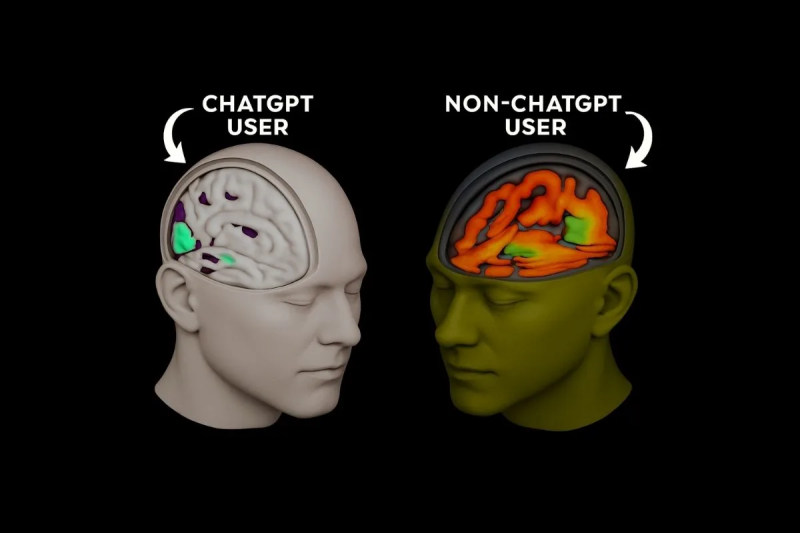
According to the study, participants who wrote essays independently demonstrated the highest neural connectivity, particularly in regions associated with creativity, memory formation, planning, and executive control. Those who used Google Search showed a noticeable decrease in brain activity, while individuals who depended heavily on ChatGPT exhibited the lowest levels of neural synchronization and cognitive effort.
Researchers described this reduction as a type of “cognitive debt”—a phenomenon where the brain gradually offloads mental work to AI systems, potentially weakening certain cognitive pathways over time. Brain activity appeared to scale down almost perfectly with the amount of external assistance, forming a striking gradient across the three groups.
Educators, neuroscientists, and tech ethicists have expressed concern that this pattern could signal a broader shift in how people engage with thinking-heavy tasks. Critics argue that continued reliance on AI writing tools may:
Reduce critical thinking ability
Encourage mental passivity
Diminish problem-solving resilience
Limit the brain’s engagement in creative generation of ideas
Several commentators, including experts cited by Nature, Wired, and The New York Times, have noted that while AI provides astonishing efficiency, its convenience may come at the cost of weakening the brain’s “effort muscles.” If students or knowledge workers rely too heavily on ChatGPT for idea formation, they may gradually lose the ability to generate complex arguments or recall information independently.
Not everyone interprets the MIT findings negatively. Supporters of AI-assisted learning argue that the brain is undergoing a natural adaptation, not a deterioration. They compare AI tools to calculators: once dismissed as harmful, calculators ultimately allowed humans to focus on deeper mathematical reasoning by automating basic arithmetic.
Proponents cited in MIT Technology Review and The Atlantic argue that offloading repetitive tasks such as drafting, summarizing, or fact-checking can free up cognitive energy for more advanced forms of thinking. In this view, lower EEG activity isn’t necessarily harmful—it could simply indicate efficient mental resource management.
AI advocates emphasize that the key lies in balanced use, ensuring that technology amplifies human intelligence rather than replacing fundamental thinking skills.
The implications of the MIT study go far beyond a single experiment. Its release has intensified global discussions about:
How AI should be integrated into classrooms
How much cognitive offloading is healthy
Whether future students will think differently than previous generations
What skills will matter most in an AI-driven workforce
Educational researchers across universities—including Harvard, Stanford, and Oxford—have begun exploring how learning models must evolve in an era where AI is both a tool and a cognitive partner. Some advocate redesigning assignments to emphasize original analysis and reasoning, while others propose teaching students how to collaborate productively with AI rather than avoiding it.
The MIT Media Lab study has become one of the most influential pieces of early research on how AI tools like ChatGPT interact with the human brain. While the evidence suggests a clear reduction in neural engagement when tasks are outsourced to AI, experts remain divided on whether this shift represents a cognitive risk or a natural evolution of how humans use technology.
What is certain, however, is that AI is transforming not just what we learn, but how our minds work—and the debate over “cognitive debt” will continue shaping the future of education, technology, and human intelligence for years to come.