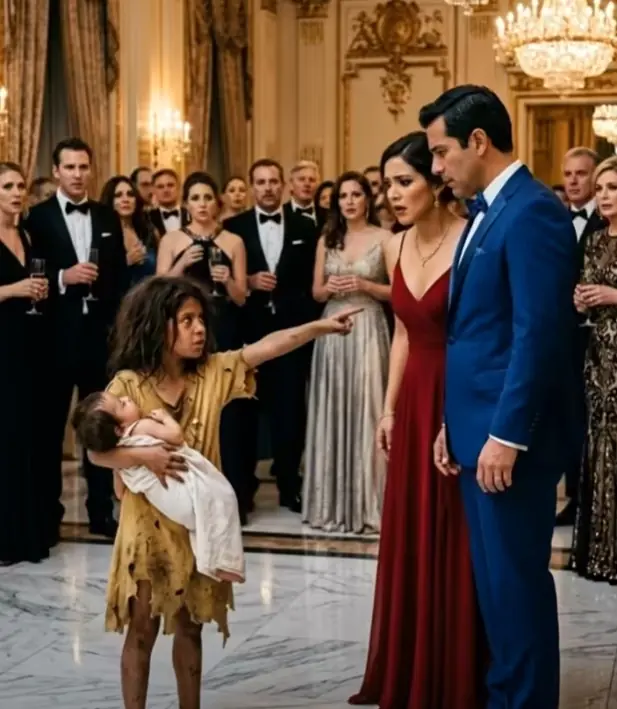
The guests laughed louder. The woman’s eyes narrowed. “If you can make my leg move in seven seconds, I’ll buy every flower in that basket.” The girl shook her head. “I don’t need you to buy flowers.” The woman tilted her head. “Then what do you need?” The girl’s stomach growled before she could answer. Her cheeks flushed with shame. “Food,” she whispered. “And five minutes of your time.” The restaurant went quiet. For the first time, the woman’s expression shifted. Only slightly. The girl stepped closer. The woman’s assistant moved to block her, but the woman raised one hand. “Let her.”
The girl knelt beside the wheelchair. She placed the basket on the floor. Then she gently touched two fingers to a point near the woman’s ankle. The woman gave a dry laugh. “This is ridiculous.” The girl looked up. “Breathe in.” The woman smiled. “No.” The girl did not blink. “Please.” Something in the girl’s voice made the woman pause. Against her own pride, she inhaled. The girl pressed gently. Then whispered: “One.” The woman’s smile faded. “Two.” Her fingers tightened around the armrest. “Three.” A tiny movement passed through her foot. The champagne glass slipped from someone’s hand and shattered beneath the table. The woman stared down. Her face emptied. “No.” The girl kept her fingers steady. “Four.” The woman’s toes moved. This time, everyone saw it. The laughter died completely. A waiter froze mid-step.
The woman gripped the table with both hands. Her voice shook. “What did you do?” The girl looked up at her. “I reminded your body of something it forgot.” The woman’s lips parted. The girl whispered: “Five.” The woman’s knee trembled beneath the silk blanket. Her eyes filled with panic. Not pain. Fear. The girl looked at her gently. “Don’t stop now.” The woman’s breathing broke. “Who taught you this?” The girl reached into the pocket of her coat. Her fingers pulled out a folded page, worn soft from years of being opened and closed. She placed it on the woman’s lap. The woman looked down. Old therapy notes. Pressure points. Breathing exercises. And at the top of the page—one name written in faded blue ink. Dr. Samuel Reed. The woman stopped breathing. The girl’s voice was small. “That was my father.”
The woman in the wheelchair stared at the name on the page. Dr. Samuel Reed. The restaurant disappeared around her. The golden lights. The crystal glasses. The expensive guests. All of it blurred into silence. Only that name remained. Her hand began to shake. “Where did you get this?” The girl lowered her eyes. “He kept it.” The woman looked up slowly. “Kept what?” The girl touched the folded page. “Your file.” The woman’s face changed. The coldness cracked first. Then came recognition. Then guilt.
Years earlier, Dr. Samuel Reed had been the only doctor who told her the truth. Not the soft truth rich people paid to hear. The real one. That she might walk again. But only if she stopped hiding behind fear. Only if she endured pain. Only if she fought harder than her pride. She had hated him for it. She had accused him of giving false hope. She had ruined his career with one phone call. Because it was easier to destroy the man who believed in her than to face the possibility that he was right. The woman looked at the girl again. Her voice was barely a whisper. “What is your name?” “Lily.” The name hit her softly.
The girl continued. “My father said you were his hardest patient.” The woman let out a broken breath. “He said that?” Lily nodded. “He said you were not weak.” The woman’s eyes turned red. “He said you were terrified.” The words struck harder than any insult. The guests sat frozen around them. No one dared to move. Lily reached into her coat again and pulled out a small photograph. In it, a younger Dr. Samuel Reed stood beside a hospital bed. Next to him sat the woman in the wheelchair, younger too, angry and proud, refusing to look at the camera. The woman touched the photograph with trembling fingers. “I fired him,” she whispered. Lily nodded. “And after that, no hospital would hire him.” The woman closed her eyes. Her face twisted with shame. Lily’s voice broke. “He never hated you.” The woman opened her eyes. Tears slipped down her cheeks. “He should have.” Lily shook her head. “He said pain makes people cruel when they don’t know where to put it.” The woman covered her mouth. The restaurant stayed silent.
Lily gently placed her fingers back near the woman’s ankle. “My father is sick now.” The woman looked at her sharply. “How sick?” Lily swallowed. “Sick enough that he sent me instead of coming himself.” The woman’s breath caught. Lily looked down at the marble floor. “He said if I found you, I should ask for only one thing.” The woman wiped her tears with shaking hands. “Money?” Lily shook her head. “No.” The woman’s voice cracked. “Then what?” Lily looked into her eyes. “He said you owed yourself the truth.” The woman froze. Lily pressed gently again. “Six.” The woman’s leg moved. A gasp swept through the restaurant. This time, it was stronger. Her knee lifted beneath the silk blanket. Her fingers dug into the tablecloth. She looked terrified. Lily whispered: “You were never completely broken.” The woman began to cry. Not quietly. Not elegantly. She cried like someone who had spent years building a palace around one lie, only to hear it crack open in front of strangers.
Lily reached for the basket beside her. The white flowers trembled in her hands. “My father didn’t want revenge,” she said. “He just wanted you to stand.” The woman looked at her legs. Then at the girl. Then at the wealthy guests who had laughed at her. For the first time in years, she looked small. Human. Afraid. “What do you want from me?” she whispered. Lily’s stomach growled again. Her face flushed. “Food first,” she said softly. “Then please come see him.” The woman gave a broken laugh through tears. It was the first honest sound anyone had heard from her all night. She reached for Lily’s hand. Not like a rich woman making a promise. Like a patient finally asking for help. “I will.” Lily nodded. “Then stand.” The woman stared at the floor. Her hands shook against the armrests. The assistant stepped forward. “Ma’am, you don’t have to—” The woman raised one trembling hand. He stopped. The whole restaurant held its breath. Lily counted softly. “Seven.”
The woman pushed down on the armrests. Her body trembled. Her face twisted with fear. For a second, it looked impossible. Then her foot pressed against the marble. Her knee locked. Her other leg followed. Slowly—painfully—the woman rose from the wheelchair. The restaurant went dead silent. Lily stood with her, one small hand holding hers. The woman was shaking. Tears fell onto her black dress. But she was standing. The white flowers slipped from Lily’s basket and scattered across the marble floor. The woman looked down at them. Then at Lily. And whispered: “Take me to your father.” Lily nodded through tears.
But before they could move—the woman looked at the guests who had laughed. Then at the wheelchair behind her. Her voice trembled, but it was clear. “Cancel my dinner.” The assistant blinked. “Ma’am?” She looked at Lily’s thin coat. Then at the restaurant door. “I’ve spent years feeding my pride.” She squeezed Lily’s hand. “Tonight, I feed the child who brought me back to life.” And as they walked toward the exit together, every person in that restaurant understood—the miracle had not been her leg moving. The miracle was the moment her heart finally did.