Chagas Disease and the Fight Against Nighttime Bugs
Facts 31/05/2026 21:37
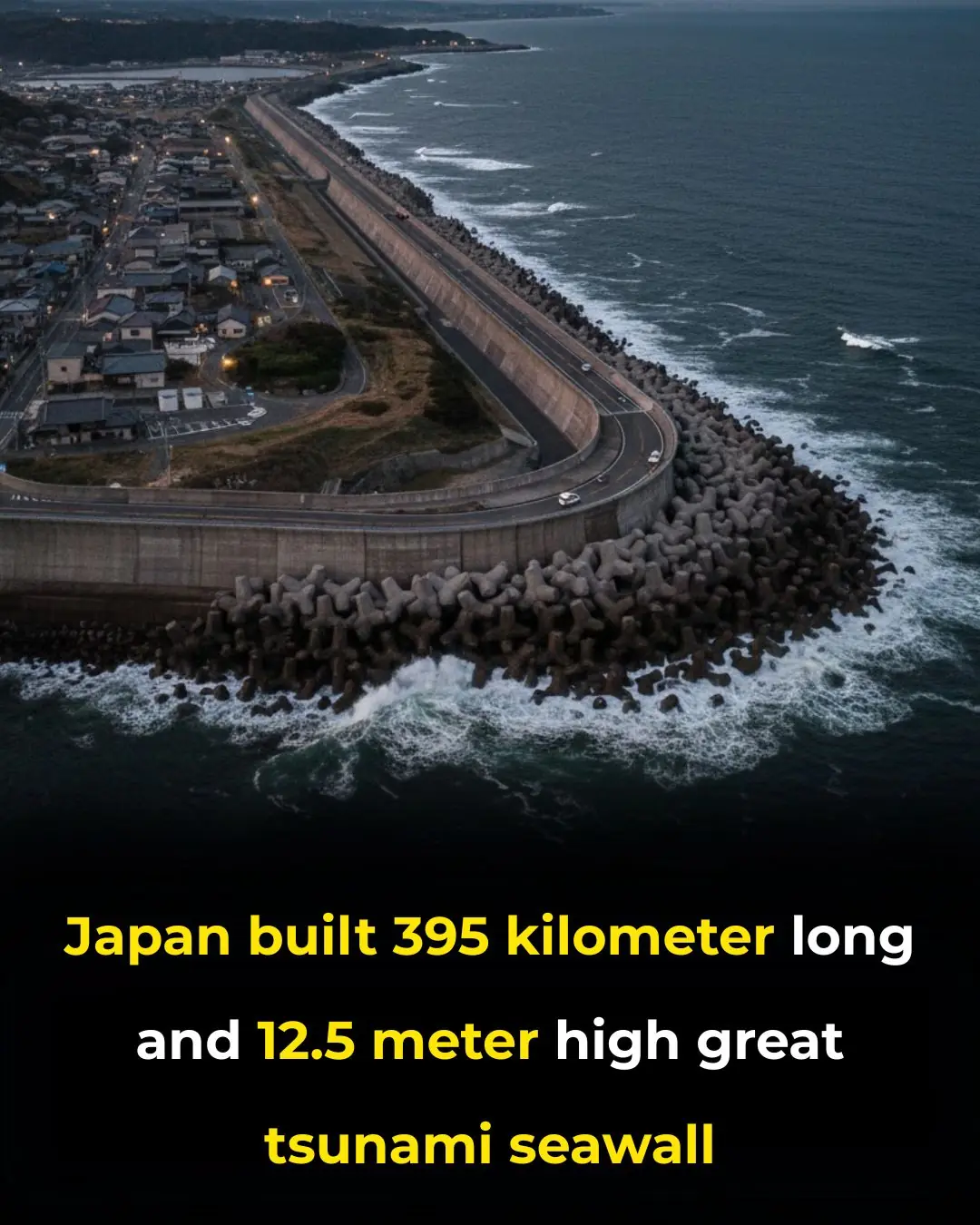
Japan’s “Great Wall”: A Testament to Resilience
In the aftermath of the catastrophic 2011 tsunami, Japan did more than just rebuild — it reimagined its defences. What emerged was not only recovery but reinvention.
Stretching some 395–430 kilometres along the northeast coast and rising in places to 12.5–14.7 metres high, the so-called “Great Tsunami Wall” (or “Great Wall of Japan”) constitutes one of the most ambitious coastal-defence programmes in modern history. The B1M+2Bangkok Post+2 In some sections, the wall is anchored on foundations reaching up to 25 metres deep, with widened bases and reinforced inner structures designed to withstand enormous hydrostatic forces from tsunami waves. The B1M+2Wodne Sprawy+2
But this project did not rely on concrete alone. Alongside the wall, Japan planted approximately nine million coastal trees, creating a vast living barrier next to the engineered structure. Geoengineer+2IndustryTap+2 The logic is simple yet powerful: by combining hardened infrastructure with ecological elements, the system aims to absorb, dissipate, or slow down wave energy — thereby offering layered protection rather than a single line of defence. Geoengineer+1
Together, the wall and the forest send a unified message: a commitment to safeguarding communities through the fusion of nature and engineering.
On 11 March 2011, a magnitude-9.0 undersea earthquake struck off Japan’s Pacific coast, triggering a tsunami — the most powerful quake ever recorded in the country. In some areas, waves reached over 30–40 metres, traveling at up to 700 km/h and inundating coastal towns within minutes. Wikipedia+1 The destruction was staggering: entire communities erased, tens of thousands of lives lost, and widespread devastation including a nuclear catastrophe at the Fukushima Daiichi Nuclear Power Plant. Wikipedia+2The Guardian+2
Prior seawalls — many only 2–4 metres high — proved utterly inadequate. In one emblematic case, the seaside pine forest known as Takata‑Matsubara, which had stood for centuries as a “green shield,” was almost entirely destroyed, its lone survivor later immortalised as the Miracle Pine Tree. Wikipedia+2Wikipedia+2
The scale of destruction forced Japan to reconsider its approach to coastal defence — not just rebuilding what was lost, but creating something far more resilient.
The new seawalls are more than simple sea-facing barriers. In addition to their remarkable height and reinforced construction, they are part of a wider strategy that includes early warning systems, strict zoning laws (limiting construction in high-risk zones), elevated ground for housing, and carefully planned evacuation routes. Nippon.com+2Wodne Sprawy+2
But perhaps most symbolically important is the ecological component: the nine-million-strong belt of coastal trees — supplemented in some towns with restored dunes, vegetated berms, and setback zones. These “living walls” serve multiple functions: they help reduce wave energy, prevent coastal erosion, stabilise shorelines, and support biodiversity. Geoengineer+2IndustryTap+2
In combining grey infrastructure with green buffers, Japan signals a shift in mindset — one that acknowledges the limits of concrete, and values the resilience embedded in nature’s own defenses.
The “Great Wall of Japan” represents more than engineering ingenuity. It is a physical tribute to the memory of 2011’s victims, a guardian for future generations, and perhaps most profoundly, a testament to the ability of a society to learn, adapt, and rebuild with dignity.
For many coastal communities, however, the wall and forest carry mixed feelings. Some residents lament the loss of sea views and traditional livelihood, feeling the wall transforms their towns into “places cut off from the sea.” The Guardian+2ABC+2 Yet alongside those grievances lies a shared understanding: in a nation long prone to the sea’s extremes, layered protection — both concrete and organic — may be the best hope for surviving what the oceans still have in store.
In that, the Great Wall of Japan stands as more than concrete and trees. It is a legacy of resilience, innovation, and respect — for both human lives and the enduring power of the sea.
“Japan’s 400 Kilometre Tsunami Shield,” The B1M, Oct. 13, 2021. The B1M
“Towering sea wall legacy of Japan’s 2011 tsunami,” Bangkok Post, Mar. 5, 2021. Bangkok Post+1
“Balancing coastal risk: Japan’s 395–430 km tsunami seawall and nature-based measures,” GeoEngineer, Jul. 6, 2025. Geoengineer
“Japan rebuilds a living wall — tsunami barriers and a forest of 9 million trees,” IndustryTap, Oct. 27, 2025. IndustryTap
“After the tsunami: Japan’s sea walls – in pictures,” The Guardian, Mar. 9, 2018. The Guardian
“2011 Tōhoku earthquake and tsunami,” Wikipedia. Wikipedia
“Ten Years After the Tsunami,” NASA Earth Observatory, Mar. 11, 2021. NASA Earth Observatory
“Takata-Matsubara,” Wikipedia. Wikipedia
“Miracle Pine Tree,” Wikipedia. Wikipedia