When the Ocean Turns Against the Shore: How Powerful Undersea Earthquakes Trigger Devastating Tsunamis and Change Coastal Communities Forever
A powerful earthquake beneath the ocean can set an enormous volume of water in motion, transforming peaceful coastlines into disaster zones within minutes. Understanding the danger, recognizing the warning signs, and preparing before disaster strikes can save countless lives.
Chapter 1: The Moment the Ocean Becomes a Threat
Imagine a peaceful coastal community on an ordinary morning.
Fishing boats are returning to the harbor after hours at sea. Families are preparing breakfast, shopkeepers are opening their businesses, and children are getting ready for school. Along the waterfront, tourists stop to admire the ocean, while residents follow the familiar routines that have shaped their lives for generations.
Nothing about the scene suggests that danger is approaching.
The sea looks calm. The streets are busy. The buildings stand exactly where they stood the day before.
Then, without warning, the ground begins to shake.
At first, the movement may feel like a passing truck or a sudden vibration beneath the floor. Within seconds, however, the shaking becomes more powerful. Furniture moves across rooms, objects fall from shelves, and people struggle to maintain their balance.
Outside, electrical wires sway. Windows break. Cracks may appear in walls, roads, and pavement.
For those living near the coast, the earthquake itself may be only the beginning of the emergency.
Far beneath the ocean, enormous geological forces may have displaced a large section of the seafloor. When this happens, the movement can push an extraordinary volume of seawater out of its normal position.
That disturbance can generate a tsunami.
A disaster that begins deep beneath the ocean may soon become a life-threatening event for communities hundreds or even thousands of kilometers away.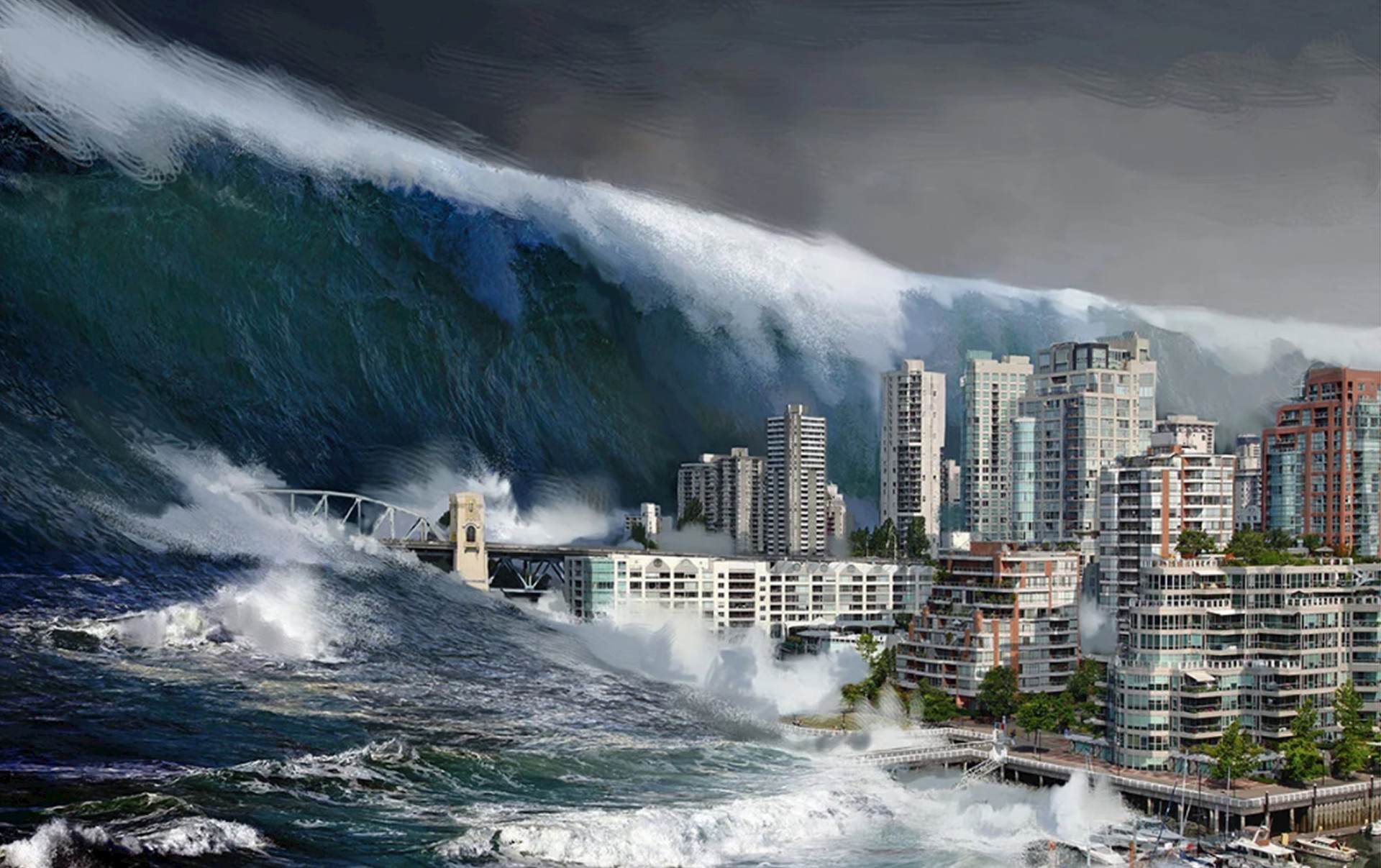
The Extraordinary Power of a Magnitude 9.1 Earthquake
An earthquake measuring magnitude 9.1 would rank among the most powerful seismic events ever recorded.
Earthquake magnitude is not measured on a simple linear scale. Scientists use logarithmic measurements to describe the enormous differences between small and large earthquakes.
According to the United States Geological Survey, an increase of one whole magnitude corresponds to approximately 32 times more energy being released.
This means that a magnitude 9 earthquake releases about 32 times more energy than a magnitude 8 earthquake.
The difference is enormous.
An earthquake of this scale generally involves movement along a vast section of a geological fault. In certain ocean regions, one tectonic plate slowly moves beneath another through a process known as subduction.
These movements occur over immense periods.
The tectonic plates may remain locked together even while powerful forces continue to build beneath the surface. Eventually, the accumulated stress can exceed the strength of the rocks holding them in place.
When the fault suddenly ruptures, sections of the Earth's crust may move by several meters or more.
If that movement includes substantial vertical displacement of the seafloor, the ocean above can be forced upward or downward.
The resulting disturbance spreads across the water.
Unlike an ordinary ocean wave generated primarily by wind, a tsunami involves movement throughout a significant depth of the water column.
It carries enormous energy across vast distances.
How a Tsunami Travels Across the Ocean
One of the most surprising facts about tsunamis is that they do not always look dangerous while traveling through deep water.
In the open ocean, a tsunami may have a relatively small wave height but an extremely long wavelength.
A vessel far offshore might barely notice the disturbance.
Yet beneath that seemingly modest surface movement, tremendous quantities of water are traveling as part of a powerful wave system.
The speed of a tsunami depends largely on the depth of the ocean.
In deep water, the waves can travel at speeds comparable to those of commercial aircraft.
This allows tsunami energy to cross entire ocean basins in a matter of hours.
As the waves approach shallower coastal waters, however, their behavior changes.
They slow down.
Their wavelengths shorten.
Their heights may increase as the moving water interacts with the seabed and coastline.
In some places, the approaching tsunami forms a rapidly rising surge rather than the towering breaking wave often portrayed in disaster movies.
Elsewhere, the water may arrive as a series of powerful waves or turbulent floods.
The exact appearance depends on the seafloor, shoreline, underwater terrain, and characteristics of the original earthquake.
What matters most is that the water can move with extraordinary force.
When Familiar Streets Become Dangerous Waterways
Picture a waterfront street lined with small restaurants, homes, and shops.
Cars are parked along the roadside. People are walking between buildings. Fishing equipment is stacked beside a harbor.
Then water begins to move inland.
Within moments, the street may become a channel of powerful currents.
Vehicles begin shifting from their parking spaces. Loose objects float away. Doors and windows are struck by debris.
Water pushes through buildings and moves around corners.
A current that appears manageable from a distance may be strong enough to knock an adult off their feet.
As floodwater advances, it can carry trees, motorcycles, vehicles, construction materials, and fragments of damaged buildings.
These objects become dangerous projectiles.
Even structures that initially survive the earthquake can be damaged when debris repeatedly strikes their walls and foundations.
In some locations, seawater can travel inland through rivers, canals, and drainage channels.
This means that people living beyond the immediate beachfront may still be exposed.
The devastation depends not only on how high the water rises, but also on how rapidly it moves and how far inland it reaches.
[Original image — retain unchanged]
Why the First Wave Is Not Always the Worst
A common misunderstanding is that a tsunami consists of one enormous wave that strikes the coastline and disappears.
In reality, tsunamis frequently involve a series of waves arriving over an extended period.
The interval between waves may be several minutes or considerably longer.
Sometimes the first wave is relatively small.
People who see the water retreat may mistakenly assume that the danger has passed.
They may leave evacuation areas, return to their homes, or approach the coast to inspect damage.
This can be a deadly mistake.