“Take your hand off the car. You couldn’t afford the mirror.”
Life stories 08/07/2026 00:32
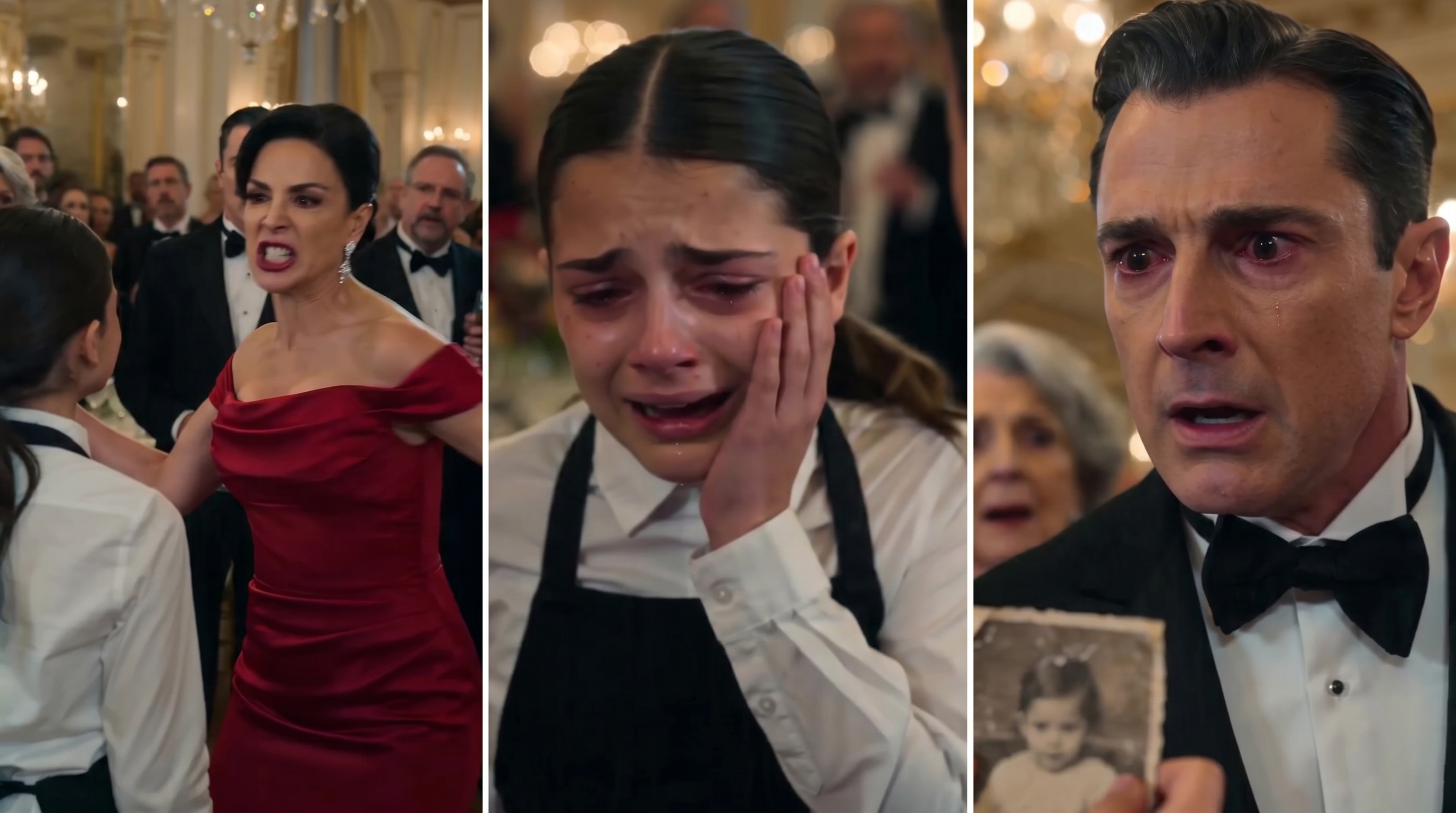
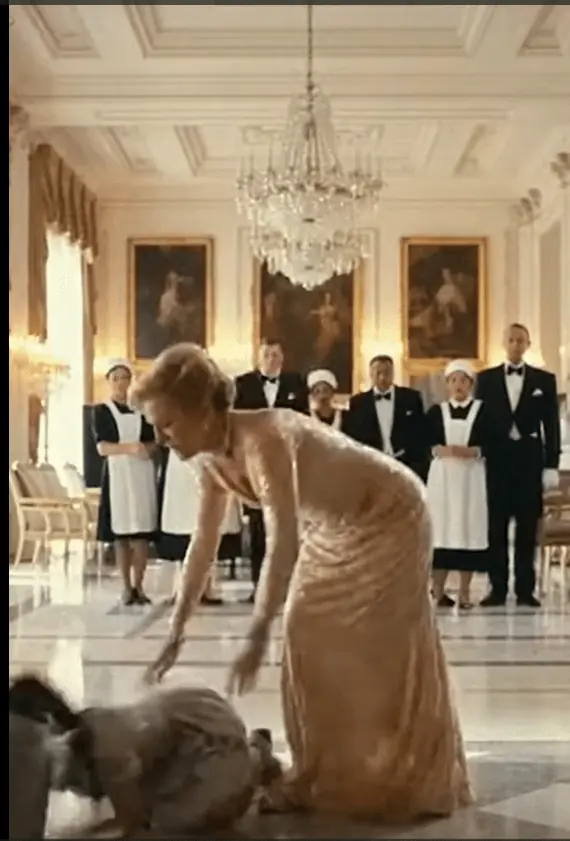
The chandeliers of the Harrington Grand Hall held ten thousand crystals, and every one of them caught the light like a trapped star. Beneath them moved the kind of people who had never once worried about the cost of bread — women in gowns that cost more than a schoolteacher's yearly salary, men with silver cufflinks and easy laughs, the comfortable architecture of old money assembled for an evening of performative generosity.
Among them, nearly invisible in her pressed black uniform, moved Maya Chen.
She was twenty-three years old, slight-framed, with dark eyes that held a quiet, steady gravity — the kind of eyes that have watched too much suffering up close and learned not to flinch. She carried a silver tray of champagne flutes with practiced grace, weaving between guests who spoke over her, around her, and through her as though she were part of the furniture.
She had been on her feet for eleven hours.
Her mother had died eight days ago.
She was here, in this hall, in this dress, because her mother's last words had made her promise to come.
✦ ✦ ✦
The woman in the red dress noticed Maya the way a hawk notices a field mouse — with the cool, detached certainty of one who expects the world to arrange itself in a hierarchy that always places her at the top.
Her name was Vivienne Harrington. Wife of Edward Harrington III, founder of Harrington Capital, one of the wealthiest men in the northeastern United States. Vivienne had learned, over fifteen years of marriage, that the best way to maintain power in a gilded room was to remind everyone around her of the precise distance between themselves and her.
She had been watching Maya for ten minutes before she made her move.
It happened near the east wall, by the ice sculpture of a swan — a beautiful and utterly useless thing, melting slowly into a silver tray.
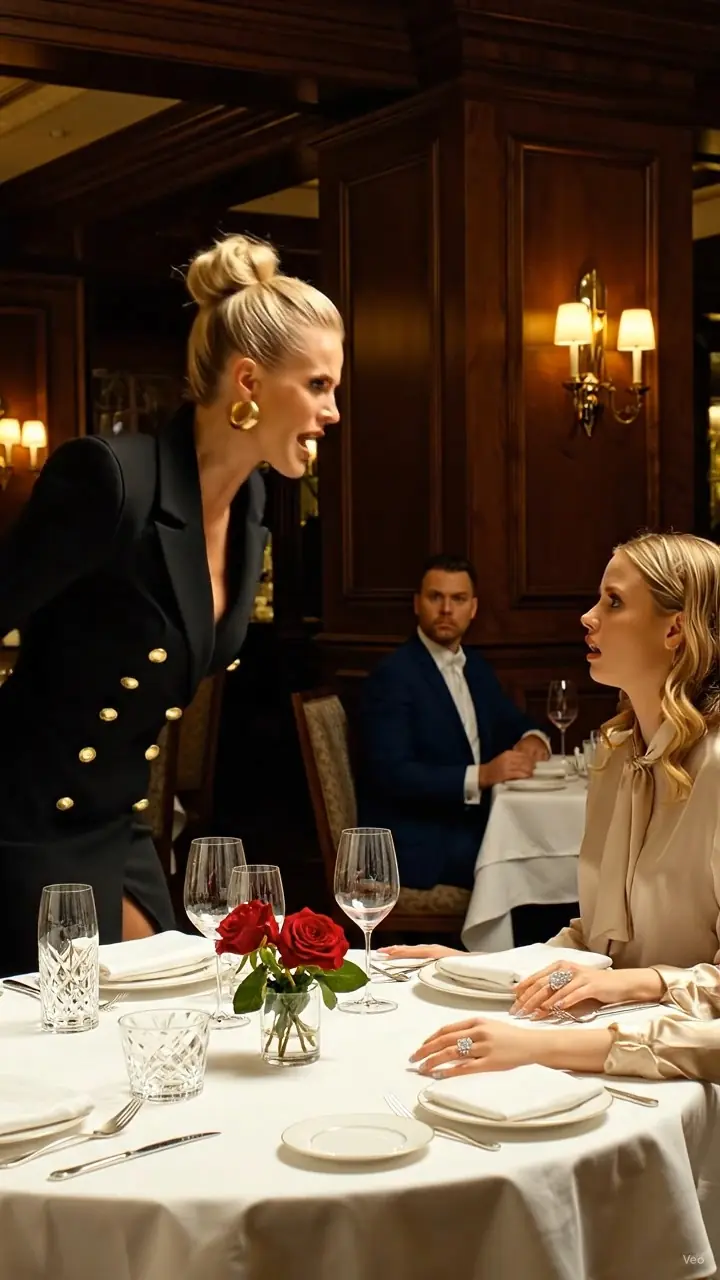
Maya stepped to the left to avoid a passing guest, and the slight movement brought her shoulder dangerously close to Vivienne's gown — a custom Valentino, deep scarlet, forty-thousand dollars of silk and spite.
Maya stopped. No contact had been made. Not a drop spilled, not a thread disturbed.
But Vivienne looked down at her with an expression that could freeze the champagne in every glass in the room.
Vivienne
"Do you have any idea what you almost did? This gown is worth more than you'll earn in five years. Perhaps ten, if you keep stumbling around ballrooms at this level of incompetence."
The room had not gone quiet — a ballroom of two hundred guests does not hush for the scolding of a waitress — but those nearby turned. The particular frequency of cruelty in a public space has a way of drawing attention, the way a dog whistle draws ears no one knew were listening.
Maya set her tray carefully on the edge of a nearby table. Her hands were steady. This surprised even her.
"I apologize, Mrs. Harrington," she said, her voice low and even. "I didn't make contact with your gown."
Vivienne
"Don't correct me. Don't you dare stand there in your little uniform and correct me. You people are all the same — no awareness, no class, no understanding of what it means to be in a space like this."
You people. The words landed with precision. Several guests nearby looked away. One woman touched her pearls, a nervous habit. A man laughed too loudly at something his companion had said three seconds ago.
Maya's eyes filled — not from weakness, but from the weight of eight days of grief cracked open by the casual viciousness of a woman who had never once been hungry. The tears came before she could stop them, and she hated that they did, because she hadn't cried once since her mother's last breath.
She had been saving it. Now it was here, uninvited, in front of the worst possible audience.
Chapter Two
Four Minutes Later
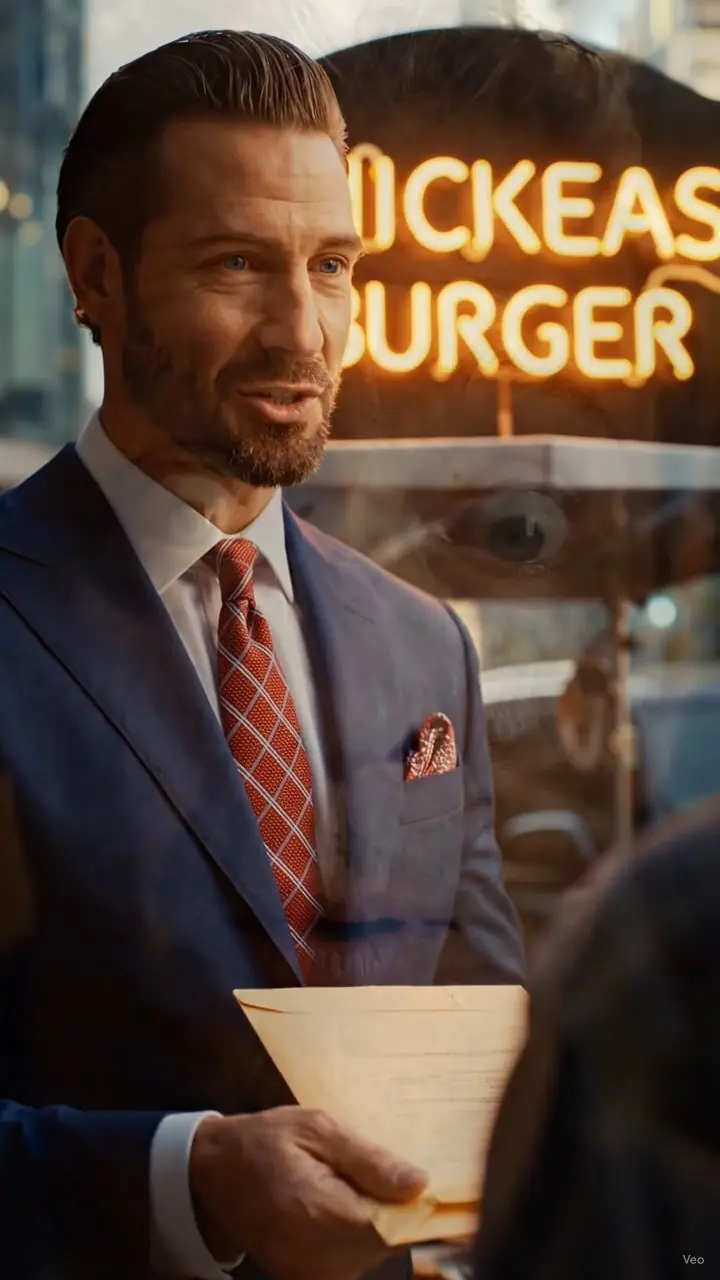
Edward Harrington had been across the room discussing venture capital with a senator when someone touched his elbow. His assistant — a young man named Thomas who had learned to navigate the Harrington household by always wearing the expression of a man carrying very careful news — leaned close.
Thomas
"Sir. There's a situation near the east wall. Mrs. Harrington and one of the waitstaff. I think you should —"
Edward had already started walking. Twenty-two years in high-stakes finance had given him an instinct for the precise moment when a situation required containment.
He came around the corner of the swan sculpture and saw his wife — chin lifted, color in her cheeks, the smile of a woman winning a fight she'd manufactured herself — and a young woman in a server's uniform with tears on her face and a stillness that struck him as profoundly, inexplicably familiar.
Edward
"Vivienne. That's enough."
Vivienne turned to him with the expression of a woman who expected alliance and found interruption instead.
Vivienne
"Edward, this girl almost ruined my —"
Edward
"I said enough."
He turned to the young woman. "I'm sorry for this. Are you alright? Can I get someone to —"
It was then that Maya reached into the small zippered pocket of her uniform — the one that broke every front-of-house dress code she'd been given — and took out the photograph.
It was old. The edges were soft from handling, the colors faded to the warm amber-browns of photographs from the early nineties. There was a young woman in it, laughing, her dark hair loose over her shoulders. She was seated on the steps of a brownstone apartment, and beside her was a young man — broad-shouldered, with dark eyes and an easy, unguarded smile that the decades had not entirely erased from the face now standing in front of Maya.
Between them, on the step below, sat a small child. Perhaps two years old. Dark-haired, with the wide, wondering eyes of someone who has not yet learned that the world can disappoint you.
Maya held the photograph out toward Edward Harrington with both hands, the way you hold something irreplaceable, something that belongs to the dead.
The room seemed to bend toward them. The music — a string quartet performing Vivaldi — continued on the other side of the hall, unaware that something was fracturing nearby.
Edward looked at the photograph.
The color left his face so completely and so quickly that Thomas, behind him, actually reached out a steadying hand toward his employer's shoulder.
Edward
"What is this?"
His voice came out broken — not with anger, but with something older and more complicated than anger. The voice of a man standing on the edge of a past he had spent twenty years pretending was a different country, a different life, a different person who had once worn his face.
Maya
"My mother told me to find my biological father."
The silence that followed was total. Even Vivienne, who had been drawing breath for another assault, found she had no words. The four of them — the billionaire, his wife, his assistant, and the girl in the server's uniform — stood in a small circle of stopped time while the crystal chandeliers went on scattering their ten thousand points of light, indifferent and gorgeous and completely unaware that a dynasty had just shifted on its foundations.
Chapter Three
The Story Behind the Photograph
Her name had been Lin Chen. She had come to New York from Guangzhou at nineteen with two hundred dollars, a sewing kit, and the particular brand of fearless optimism that belongs exclusively to the very young and the very determined.
She had met Edward Harrington — then Edward Harrington Jr., twenty-four, not yet the third because his grandfather was still alive, not yet the billionaire because his father's company was merely prosperous rather than obscene — at a community art show in Brooklyn. He had been there as a favor to a college friend. She had been there because she helped build the display frames and the gallery let her show two of her photographs in exchange.
He had stood in front of one of her photographs for a very long time. It was a picture of a woman washing windows from the outside of a building, her harness barely visible, the city spreading out enormous and indifferent below her. He had not known, looking at it, that the photographer was standing three feet to his left.
Edward — 1998, age 24
"She looks completely unafraid. How do you get someone to trust you enough to look like that?"
Lin — 1998, age 21
"You don't. You wait until they forget you're there."
They had been together for two years. Not secretly — Edward's father knew, disapproved quietly, said nothing directly because Edward's grandfather was still alive and the old man had a fondness for photographs of women washing windows. But the disapproval was a presence in every family dinner, every firm handshake with the sons of other wealthy men, every carefully worded mention of "someone more suitable."
When Lin became pregnant, she had been twenty-three. Edward had been twenty-five and still in the process of learning which version of himself he intended to be.
He chose the version his family had already paid for.
He gave Lin a check — a generous one, by the standards of someone who has never had to consider what generous means when you are alone and frightened and twenty-three — and a phone number for a lawyer who would handle the details. He told himself it was the only practical solution. He told himself this for twenty years, with the particular discipline of a man who has built a considerable fortune on the ability to make a decision and not look back.
Lin had kept the check. She had not cashed it. She had raised Maya on her own — working two jobs, then one better job, then building a small photography studio in Queens that paid the bills and occasionally something beyond the bills. She had been, by every account that mattered, an extraordinary mother.
She had been diagnosed with pancreatic cancer fourteen months before the night of the gala. She had told Maya eight months before that.
And in the last week of her life, clear-eyed and calm in the way that some people become when all the pretending is finished, she had told Maya the rest.
She had pressed the photograph into Maya's hands. And she had written a letter.
Maya took the letter from the same pocket now — the same pocket that had broken every dress code — and held it out toward Edward Harrington.
Edward,
I don't write this to ask you for anything. I am past asking. I write because Maya deserves to know where she comes from, and because I promised myself, when she was born, that I would never let her grow up ashamed of herself or uncertain of her worth.
She is extraordinary. She has my eyes and your stubbornness, and she has something neither of us gave her — a kind of moral clarity I have spent a lifetime trying to earn.
I'm not angry with you. I was, for a long time. But anger is expensive and I've had better things to spend my energy on.
I only ask one thing. Not money. Not your name, unless you both choose that. Only this: look at her. Really look at her. And if you have any piece of yourself left that remembers who you were at twenty-five, before you chose the easier road — let her in.
She is the best thing that ever happened to me. I hope someday you understand what that means.
— Lin Chen
Written April 3rd, in what I am told is likely my last month.
Chapter Four
The Architecture of a Marriage, Examined
Vivienne Harrington had married Edward because she was in love with him, and then she had spent fifteen years discovering that the man she married was not entirely the man she had fallen in love with — that there was a part of him, some room behind a locked door, that she had always sensed but never been permitted to enter. She had assumed it was the past of all wealthy men: a guilt about privilege, a regret about some business ruthlessness, some darkness that the very successful tend to carry.
She had not imagined this.
She stood now looking at a young woman with dark eyes and Edward's exact brow line and Lin's letter open in her husband's hands, and she felt something happen to her arrogance that had never happened to it before. It didn't dissolve — it didn't transform, in some redemptive rush, into compassion. It simply became irrelevant. The perfectly tailored machinery of Vivienne's social superiority had been built to operate in a world where she knew all the pieces on the board.
She hadn't known about this piece.
She looked at Maya — really looked at her, for the first time, as a person rather than as a threat or a subordinate — and saw a young woman who was exhausted and grieving and standing in the ruins of a plan that had taken enormous courage to execute. Who had walked into this gilded hall with a dead woman's last wish folded in her pocket and had stood there while Vivienne called her incompetent and reminded her of her place.
The shame, when it arrived, was total and silent.
Vivienne
"I — I didn't know —"
It was the most honest sentence Vivienne Harrington had said in years. She left it unfinished because she couldn't find an ending that didn't sound like an excuse.
Maya looked at her. Not with anger — Maya had spent her energy getting here, and there was none left for anger. With something simpler and harder: clarity.
Maya
"I didn't come to cause trouble. I came because my mother asked me to. That's all."
Chapter Five
11:40 PM — The Private Study, West Wing
They left the ballroom. Thomas managed this with the quiet competence of a man whose entire career depended on managing unmanageable situations, steering guests with gentle redirections, allowing the string quartet to draw attention back to Vivaldi, manufacturing the impression that whatever had happened near the east wall ice sculpture was already forgotten.
The four of them — Edward, Vivienne, Maya, and Thomas, who had been instructed to stay — sat in the library of the Harrington house's private wing: a room of floor-to-ceiling books that no one read, leather chairs that cost more than Lin's first camera, and a fireplace that burned with the crisp efficiency of something maintained by staff.
Edward sat across from Maya. He had read the letter three times. He held it carefully, as though it might dissolve.
For a long time, no one spoke. The fire was the only voice in the room.
Edward
"She kept the check."
Maya
"She kept it in the same envelope you sent it in. I found it in her desk. She never told me what it was for until — until near the end."
Edward
"She could have used it. She should have —"
Maya
"She said accepting it would have meant accepting that you were paying to not be my father. She'd rather be poor than agree to that."
Edward closed his eyes. The firelight moved across his face — the face in the photograph, twenty-five years older, carrying the particular weight of a man who has just been handed a precise account of the cost of one decision made a long time ago when he was still young enough to believe that decisions could be contained.
Vivienne sat slightly apart, her red gown now feeling not like armor but like evidence — of the performance she'd been giving for fifteen years, of the world she'd built inside this marriage, of the evening she could not take back.
Vivienne — quietly, not to anyone in particular
"Did she struggle? Your mother. Growing up — was it very hard?"
Maya considered this. She could have said: yes, we were poor, there were nights when dinner was rice and kindness. She could have deployed her life as an indictment. But Lin had not raised her for indictments. Lin had raised her to photograph the truth without editorializing it.
Maya
"She was happy. She had me, and her camera, and she made something she was proud of. She wasn't happy because life was easy. She was happy because she knew what mattered to her."
The silence that followed this was a different kind of silence than the one in the ballroom. That one had been stunned and witnessed. This one was private, and it held room for grief and guilt and the specific shame of recognizing, late, what you failed to value when it was available to you.
Edward set the letter on the table between them. He placed the photograph beside it. He looked at Maya — his daughter, twenty-three years old, wearing a server's uniform, sitting in his library at midnight with the composure of someone twice her age — and the words he needed were not, in the end, complicated.
Edward
"I'm sorry. I know that's — I know it doesn't —" He stopped. Started again. "I'm sorry for what I did to your mother. And I'm sorry that you grew up without —" Another stop. His voice had developed a crack in it, like expensive china under too much pressure. "I would like to know you, if you'll allow it. I don't deserve that. I'm asking anyway."
Maya looked at him for a long moment. She thought about her mother, who had spent twenty-three years never once speaking bitterly of this man, never poisoning Maya against a ghost she didn't know. Who had spent her last weeks not in anger but in the careful work of making sure the people she loved had what they needed when she was gone.
Who had handed Maya a photograph and said: find him. Not: confront him. Not: make him pay. Find him.
Maya
"My mother didn't send me here to punish you. She sent me here so I'd know where I came from. So I wouldn't spend my life with a question mark where a father was supposed to be." She paused. "I don't know what we are to each other. I don't think either of us can know that tonight. But I'm not closed to finding out."
Epilogue
Six Months Later
The DNA test confirmed what the photograph had already told everyone who was paying attention. Edward Harrington III had a daughter. This was not, in the end, the scandal that the gossip websites had hoped for — the announcement was quiet, deliberate, handled with the same careful communication that Thomas brought to everything in Edward's professional life.
The public response was, after a brief flurry, quickly overtaken by other news. The private response was more complicated and more lasting.
Vivienne did not leave Edward, nor did Edward ask her to. They began, instead, the slower and more difficult work of honesty — the kind of honesty that emerges when pretending is no longer available. Their marriage became something different from what it had been: smaller, less ornamented, more real. Whether it would survive the renovation, neither of them knew. But they were, for the first time in years, asking genuine questions of each other.
Maya did not move into the Harrington house. She did not change her name. She did not accept, in a gesture of narrative convenience, the erasure of the life Lin had built for her.
She accepted, instead, a visit on a Tuesday afternoon in March — a coffee, at a small place in Queens she'd been going to since she was fifteen — where she and Edward sat across from each other in the uncertain, tentative way of two people who share blood and nothing else yet, and are trying to determine whether yet might ever become something.
He brought flowers, because Thomas had suggested it and he hadn't known what else to do. She brought a photograph she'd taken of the street outside her mother's old studio — a woman washing windows from a scaffold, the city enormous behind her, perfectly unafraid.
She slid it across the table without comment.
He recognized it immediately. He looked at it for a long time, the way he'd once stood in front of her mother's work in a Brooklyn gallery at twenty-four, before he knew what it would cost him to walk away.
This time, he didn't walk away.
✦
Lin's camera — a battered Nikon F3 that she'd bought secondhand in 1995 and used for thirty years — sat on Maya's desk in her apartment in Astoria. Beside it, in a simple frame, was the old photograph: Lin, Edward, and the small dark-haired child on the brownstone steps, caught in the amber light of a summer afternoon that had no idea how long its shadow would be.
Below the photograph, Maya had taped a strip of paper with her mother's handwriting on it — taken from an old journal she'd found in the last boxes she'd unpacked.
It said, in Lin's precise, slanted script: The truth always costs something. But so does keeping it buried. At least the truth, when it finally surfaces, has the chance to grow into something.