Why Your Fingers Wrinkle in Water
Tips 27/06/2026 22:22
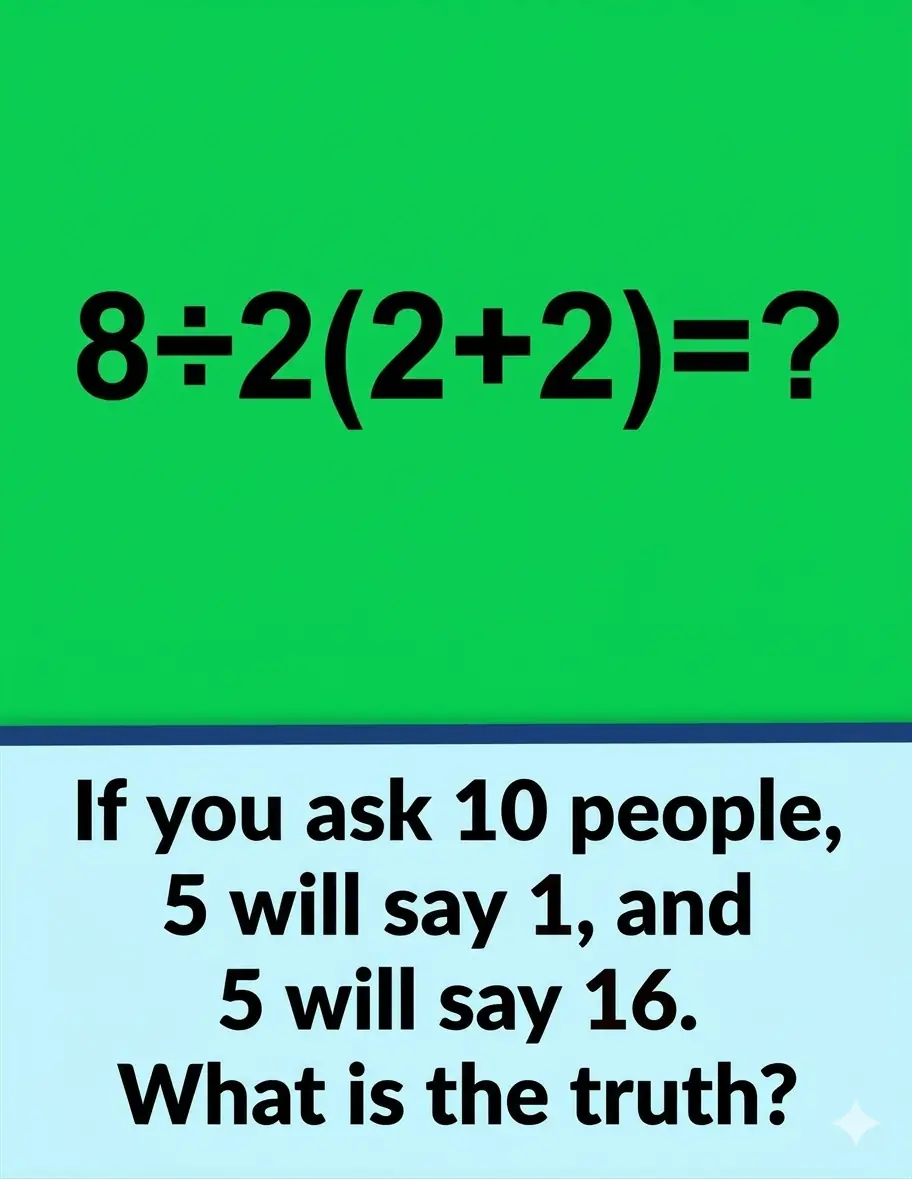
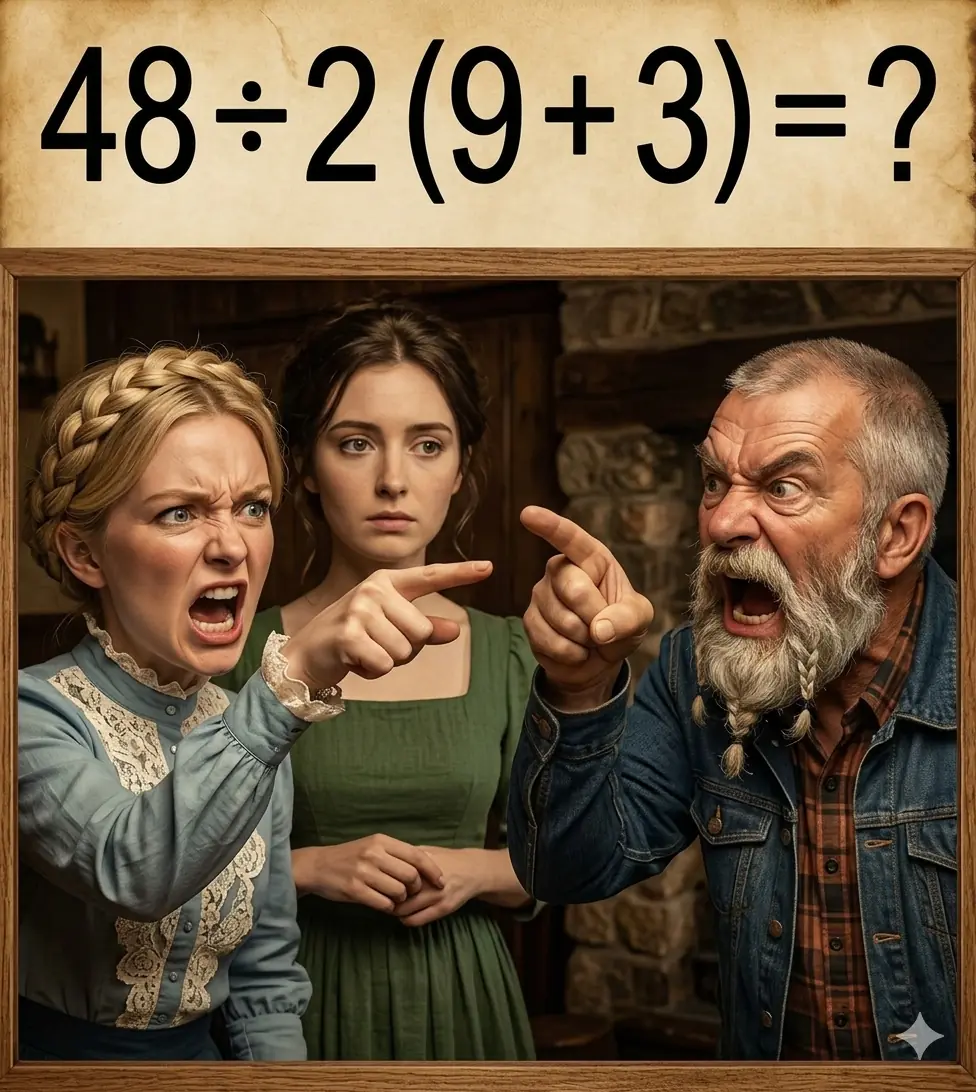
If you have spent any time on social media recently, you have likely encountered the simple looking math problem above: 8 : 2(2 + 2) = ?
At first glance, it looks like elementary school arithmetic. However, as the image suggests, this problem has caused a "heated debate." Millions of users—including engineers, mathematicians, and teachers—have argued themselves in circles, stubbornly adhering to one of two conflicting camps: Camp 1 or Camp 16.
But how can one simple arithmetic problem have two vastly different "correct" answers?
The truth is, the fault lies not with your mathematical ability, but with the expression’s inherent ambiguity.
Before the debate begins, there is one thing everyone can agree upon: Parentheses first.
The standard order of operations (whether you learned it as PEMDAS, BODMAS, or BEDMAS) dictates that we solve whatever is inside the brackets or parentheses first.
Step 1: Solve (2 + 2) = 4$
Now, the expression is simplified to: 8 \2(4)
This is where the fork in the road appears. The question now boils down to: What takes priority, the division $(\div)$ or the implied multiplication next to the parenthesis (2(4))
Camp 16 follows a strict reading of the standard order of operations taught today in many schools, particularly in North America.
The acronym used is PEMDAS:
Parentheses (done)
Exponents (none)
M/D Multiplication & Division
A/S Addition & Subtraction
Crucial Rule: In PEMDAS, Multiplication and Division do not have separate priority. They are on the same level. When you are left with only multiplication and division, you must execute them from left to right.
Following Path A:
Expression: 8 \div 2 \times 4
Leftmost operation is division: 8 \div 2 = 4
New expression: 4 \times 4
Final Result: 16
This is how most standard computer calculators (like the iPhone or Google calculator) and modern scientific tools will solve the problem.
Camp 1 argues that there is another mathematical convention that modern school acronyms sometimes overlook: Implied Multiplication.
This camp contends that multiplication indicated by juxtaposition (a number directly next to a grouping symbol, like 2(4) or 2x binds the numbers together more tightly than the standard multiplication symbol (\times)
They view the term 2(2+2) as a single bundled factor that must be fully simplified before any other operations outside it can take place.
Following Path B:
Expression: 8 \div 2(4)
Execute the implied multiplication first to "clear" the parentheses: 2(4) = 8
New expression: 8 \div 8
Final Result: 1
This convention is often preferred by people with stronger backgrounds in algebra and physics, where 1/2x is widely interpreted as 1/(2x), not (1/2)x. Interestingly, some older scientific calculators (such as older Texas Instruments or Casio models) have actually been shown to output "1" when this exact sequence is typed in.
So, who is correct? The reality is that both interpretations can be mathematically justified depending on which established convention you prioritize.
A true mathematician would say the question itself is poorly written. It relies on outdated notation (the obelus symbol \div instead of a fraction bar) and omits a required multiplication symbol. Good math notation is designed to remove confusion, not create it.
To be clear:
If the author meant 16, they should have written: (8 \div 2)(2 + 2)
If the author meant 1, they should have written: 8 \div [2(2 + 2)]
The debate surrounding 8 \div 2(2 + 2) isn't about people being bad at math. It is a brilliant example of how mathematical conventions can be confusing when an equation is written in an ambiguous way.
Next time you see it, don't get into an argument. Just appreciate the linguistic complexity of a subject that is supposedly universal.






Skip the Store-Bought Drinks: This Homemade Strawberry Juice Is Bursting With Fresh Flavor and Ready in Just 10 Minutes

A Closer Look at the Juicy Steak: Exploring a Culinary Delight
Math problem from school that many adults fail: Solve it without a calculator