“I… can’t breathe…”
The words barely made it past her lips before they shattered into silence.
At first, no one moved.
It was the kind of restaurant where nothing ever went wrong.
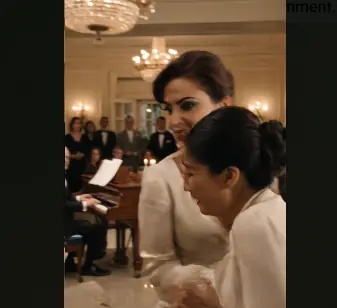
Morning light poured through floor-to-ceiling windows, soft and golden, settling gently across polished marble and white linen tables. Crystal glasses caught the sunlight like quiet applause. A pianist in the corner had been playing something light—something forgettable—until the note faltered, then broke entirely.
Forks paused midair.
Conversations froze.
And at the center of it all, she stood.
Evelyn Carter.
Forty-two.
A name that carried weight in boardrooms, in headlines, in the quiet, envious whispers of people who would never reach her world.
Her hand tightened slowly around her throat.
Not dramatic.
Not sudden.
Just… wrong.
Her fingers pressed harder.
Her breath caught.
The fork slipped from her other hand and struck the plate with a soft, fragile clink that echoed far louder than it should have.
She tried to inhale.
Nothing came.
Her chest rose.
Stopped.
Something was stuck.
Deep.
Unmoving.
Her eyes widened—not with fear at first, but confusion. As if her body had betrayed her in a way she didn’t understand.
Then panic arrived.
Sharp.
Cold.
Immediate.
She pushed her chair back too fast. It scraped harshly against the marble floor. The table jolted. A glass tipped, water spilling across the cloth in a spreading stain.
“I… can’t breathe…”
The words were thinner now.
Broken.
Barely sound.
A few people stood.
But they didn’t move closer.
They leaned back instead.
As if danger could be contagious.
As if proximity might make them responsible.
“Help her!”
Someone said it.
Loud enough.
Urgent enough.
But still—no one touched her.
A man in a tailored suit took a step forward… then stopped.
A woman covered her mouth but stayed rooted where she stood.
The waiter nearest to Evelyn froze completely, tray still balanced in his hand, eyes wide but empty of action.
Evelyn tried again to breathe.
Her body jerked forward.
Nothing.
Her throat burned.
Her vision blurred at the edges, light stretching and warping as if the room were bending around her.
She stumbled into the table.
Harder this time.
The glass fell completely, shattering against the floor.
The sound cut through the room like something breaking beyond repair.
Still—
No one touched her.
And then—
A sound that didn’t belong.
Footsteps.
Fast.
Light.
Out of place against polished marble and quiet wealth.
The entrance doors swung open.
Too quickly.
Too forcefully.
Heads turned—not out of concern, but irritation.
And that’s when they saw him.
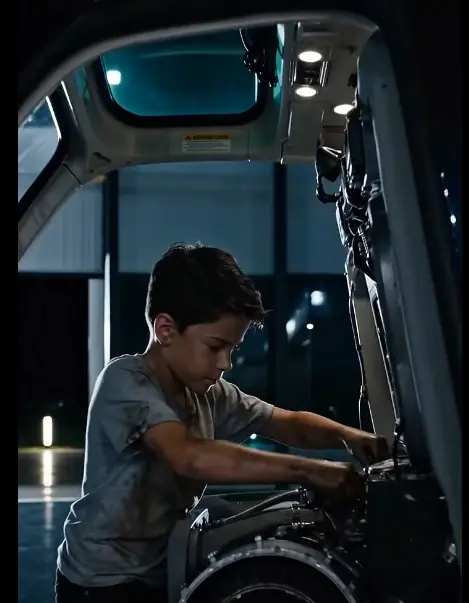
A boy.
Eight, maybe ten.
Too thin for his age.
Clothes worn past their purpose—fabric stretched, faded, torn at the edges.
Hair uneven, pushed in every direction like it had never known a mirror.
He didn’t hesitate.
Didn’t slow down.
Didn’t look at anyone.
He ran straight through them.
People stepped aside instinctively—not out of kindness, but discomfort.
As if he didn’t belong in the same space as them.
“Move!”
His voice cracked through the room—not loud, not powerful, but certain.
And somehow—
They listened.
He reached her just as her knees began to buckle.
No pause.
No question.
He stepped behind her, arms wrapping around her upper abdomen with a precision that didn’t belong to a child.
His hands locked together.
Pulled inward.
Upward.
Hard.
The first thrust.
Nothing.
Evelyn’s body jerked.
Her breath still trapped.
Her head tilted back, eyes glassy, unfocused.
For a fraction of a second, doubt flickered across the boy’s face.
Then it vanished.
He tightened his grip.
Adjusted his stance.
Pulled again.
Stronger.
Faster.
More desperate.
The second thrust hit like a shockwave.
And then—
Release.
A sharp, violent expulsion.
The blockage dislodged, striking the plate with a small, wet sound that echoed in the silence.
Evelyn collapsed forward.
Air slammed into her lungs.
Rough.
Painful.
Alive.
She gasped.
Again.
And again.
Each breath dragging her back from somewhere she hadn’t even realized she had already crossed into.
The room didn’t move.
Didn’t speak.
Didn’t breathe.
Because suddenly—
They were all watching something else.
Not her.
Him.
The boy stepped back.
Just one step.
His chest rose and fell quickly, breath uneven, shoulders trembling slightly from the force he had used.
He didn’t look proud.
Didn’t look scared.
Just… tired.
Evelyn’s hands gripped the edge of the table.
Her body shook as oxygen returned, flooding through her veins too fast, too violently.
Her vision steadied.
Slowly.
And then—
She looked up.
At him.
Really looked.
Her brows pulled together.
Confusion first.
Then something else.
Something deeper.
Recognition trying to surface.
“You…”
The word slipped out before she could stop it.
Her voice was hoarse.
Unsteady.
Her eyes searched his face, tracing lines that didn’t belong to memory—yet felt familiar anyway.
Why?
Why did she know this face?
Why did something inside her chest tighten—not with fear now, but something heavier?
And then—
It came.
Not as a thought.
But as a feeling.
A shift.
A pull.
The world blurred again—
But this time, not from lack of air.
From memory.
—
Days earlier.
The city had been colder.
Harsher.
The kind of morning that made people walk faster, heads down, eyes away.
Evelyn had stepped out of her car without thinking.
Her heels clicked sharply against the pavement, her coat pulled tight around her body, her mind already three meetings ahead of where she was.
She almost didn’t see him.
Almost.
He sat near the curb.
Small.
Still.
Too still.
His back pressed against the cold concrete, knees pulled in, arms wrapped around himself as if he were trying to hold what little warmth remained.
His eyes didn’t follow people anymore.
Didn’t ask.
Didn’t hope.
They just… existed.
And then—
He whispered.
“I’m so hungry…”
Not to anyone.
Not expecting an answer.
Just… saying it.
The words didn’t carry far.
But they reached her.
Evelyn stopped.
Just for a second.
Long enough to look.
Really look.
Not at a problem.
Not at a situation.
At him.
Something shifted inside her then.
Subtle.
But undeniable.
She turned.
Walked into the nearest café.
Ignored the confused glance from the barista as she ordered more than she needed.
Came back out.
Knelt down.
Her world—expensive, controlled, distant—lowering itself to meet his.
She placed the food gently into his hands.
Warm.
Real.
Enough.
“Eat…”
Her voice had been softer than she expected.
“You’ll be okay.”
He didn’t respond right away.
Just stared at the food.
As if it might disappear.
As if it wasn’t meant for him.
Then slowly—
He nodded.
Barely.
And she left.
Because that’s what people like her did.
They helped.
And then moved on.
—
Back to the present.
Back to breath.
Back to life.
Evelyn’s eyes widened slightly as the memory settled into place.
Not fully formed.
But enough.
Her gaze locked onto him again.
This time, not searching.
Knowing.
The boy stood quietly.
Still breathing hard.
Still watching her—not with expectation, not with gratitude.
Just… calm.
Like this was simple.
Like this was normal.
Like this was something that had already been decided long before this moment happened.
“You…”
Her voice broke again.
But not from lack of air this time.
From something else entirely.
Something heavier.
Something that stayed.
The boy didn’t step forward.
Didn’t speak right away.
He just met her eyes.
Steady.
Certain.
And then—
Softly.
Clearly.
Without hesitation—
“You saved me first.”
The words didn’t echo.
They didn’t need to.
Because they landed exactly where they were meant to.
Not in the room.
Not in the air.
But inside her.
Deep.
Unavoidable.
And for the first time that morning—
Evelyn Carter didn’t look like the most powerful person in the room.
She looked like someone who had just realized something far more important than power.
Something simple.
Something rare.
Something that, for once—
Couldn’t be bought.
Only given.
And returned.
For a long moment, no one spoke.
The restaurant, once filled with quiet conversations and controlled elegance, now held something else entirely—something raw, something exposed. The kind of silence that didn’t belong in places like this.
Evelyn’s fingers tightened slightly against the edge of the table.
Not in panic.
Not anymore.
In realization.
Because the world she understood—where everything had a price, a structure, a clear exchange—had just been broken by something she couldn’t quantify.
Her eyes didn’t leave the boy.
“You…” she said again, softer this time, as if saying it differently might help her understand. “What’s your name?”
The question felt simple.
But it wasn’t.
Because it was the first time she had ever asked him.
The boy hesitated.
Just slightly.
Not out of fear—but as if he was deciding whether the answer mattered now.
“Daniel,” he said.
His voice was quiet, steady.
Evelyn nodded once.
As if committing it to memory.
Daniel.
The name settled into her like something she should have known already.
Around them, the room began to shift.
People whispered.
Phones lowered.
The tension that had frozen them moments ago now turned into something more familiar—curiosity, discomfort, judgment.
A man near the back leaned toward another guest.
“Kid just ran in here like that,” he muttered. “Where did he even come from?”
Another voice followed, softer but sharper.
“He doesn’t belong here.”
The words were quiet.
But not quiet enough.
Daniel heard them.
Of course he did.
His shoulders stiffened—barely.
A reflex.
A memory.
Evelyn saw it.
And something inside her changed again.
“Enough.”
Her voice cut through the room—hoarse, weakened, but unmistakably authoritative.
Every whisper stopped.
Every eye turned back to her.
She straightened slowly, still unsteady, but standing on something far stronger than physical balance.
“This boy saved my life.”
No hesitation.
No softness.
A statement.
Final.
The kind of statement that didn’t ask for agreement.
Silence followed.
A different kind now.
Not uncertain.
Corrected.
The manager stepped forward quickly, posture shifting, tone adjusting to match the power dynamic that had just reasserted itself.
“Of course, Ms. Carter,” he said. “We—we didn’t realize—”
“You didn’t act.”
Evelyn’s gaze moved to him.
Not angry.
Worse.
Clear.
The manager faltered.
Because there was no defense for that.
No version of events where his hesitation looked like anything but what it was.
“I…” he started, then stopped.
Because she wasn’t asking for an explanation.
She had already seen enough.
Evelyn turned back to Daniel.
Up close, the details were clearer now.
The worn sleeves.
The dirt at the edges of his cuffs.
The way he stood—not relaxed, not tense—just ready to leave.
As if staying had never been part of the plan.
“You should sit,” she said.
Daniel shook his head.
“I’m okay.”
The answer came too quickly.
Too practiced.
Evelyn recognized it instantly.
It was the same tone people used when they had learned not to expect anything more.
That was the second moment something shifted inside her.
Not the realization.
Not the memory.
But the understanding of what came after.
“You helped me,” she said carefully. “Let me help you.”
Daniel didn’t respond right away.
His eyes flickered—not around the room, not at the people—but toward the entrance.
Toward the door he had come through.
Toward the outside.
Evelyn followed his gaze.
And for the first time—
She noticed.
A figure standing just beyond the glass.
Still.
Watching.
A woman.
Late twenties, maybe early thirties.
Dressed simply—but not like someone without means.
Her posture was too controlled.
Her gaze too focused.
She wasn’t just watching Daniel.
She was watching Evelyn.
Waiting.
Evelyn’s attention sharpened.
“Is someone with you?” she asked quietly.
Daniel’s jaw tightened.
Just slightly.
Then he nodded.
“My sister.”
The word came out flat.
But something about it didn’t sit right.
Not wrong.
Just… incomplete.
Evelyn looked back toward the glass.
The woman hadn’t moved.
Hadn’t stepped in.
Hadn’t called out.
Just… observed.
That was the third shift.
And this time, it wasn’t emotional.
It was instinct.
The same instinct that had built her career.
That had protected her in rooms where power wasn’t spoken—it was tested.
She turned back to Daniel.
“Bring her in,” she said.
Daniel hesitated.
Longer this time.
Then finally—
He shook his head.
“She said not to.”
Evelyn’s eyes narrowed slightly.
“Why?”
Daniel didn’t answer.
Because he didn’t know.
Or because he wasn’t supposed to say.
Both possibilities were equally clear.
Evelyn took a slow breath.
Her body still weak.
Her mind not.
“Daniel,” she said, voice softer now. “Did she tell you to come in here?”
Silence.
A small one.
But heavy.
Then—
“Yes.”
The word landed differently.
Not confident.
Not uncertain.
Just… honest.
“And did she tell you what to do?”
Another pause.
Then—
“No.”
Evelyn leaned back slightly.
Not physically.
Mentally.
Pieces were moving now.
The timing.
The positioning.
The observation.
Too precise to be coincidence.
But not malicious.
Because if it had been—
Daniel wouldn’t have acted the way he did.
There had been no hesitation in him.
No calculation.
Just action.
Which meant—
Whatever this was—
It hadn’t been about the moment.
It had been about the choice.
Evelyn stood fully upright now.
Ignoring the faint dizziness.
Ignoring the quiet concern from the staff.
Her focus locked onto the door.
“Invite her in,” she said to the manager.
He didn’t hesitate this time.
Within seconds, the woman stepped inside.
Calm.
Measured.
Unapologetic.
She walked directly toward them.
Not rushed.
Not cautious.
As if she had always intended to be here.
Up close, the resemblance was clearer.
Not siblings.
Not exactly.
But connected.
In the eyes.
In the stillness.
She stopped a few feet away.
“Ms. Carter,” she said.
Polite.
Even.
Prepared.
Evelyn studied her.
“You sent him.”
Not a question.
A conclusion.
The woman didn’t deny it.
“Yes.”
The room shifted again.
Whispers returned—quieter, sharper.
Evelyn didn’t look away.
“Why?”
The woman exhaled slowly.
As if she had been waiting for that question.
“Because you wouldn’t have listened to me.”
The answer was immediate.
Unflinching.
Evelyn’s expression didn’t change.
But something inside her did.
“Explain.”
The woman glanced at Daniel.
Just briefly.
Then back.
“My name is Lila,” she said. “I run a small foundation downtown. Food access. Emergency support.”
Evelyn’s mind moved quickly.
Names.
Networks.
Connections.
She had seen something like that before.
Maybe even funded it—
Indirectly.
“I’ve tried to reach you,” Lila continued. “Emails. Calls. Proposals.”
No recognition surfaced.
Which meant—
They hadn’t reached her.
Or hadn’t mattered enough to stay.
“You didn’t respond,” Lila said.
Not accusing.
Just stating.
“And this—” Evelyn gestured slightly toward Daniel “—was your solution?”
Lila shook her head.
“No.”
A beat.
Then—
“This was his.”
Evelyn’s gaze snapped back to Daniel.
He didn’t look away.
Didn’t shrink.
“He recognized you,” Lila said quietly. “From the street. He told me what you did.”
Evelyn’s breath caught slightly.
Not from obstruction this time.
From something else.
“He wanted to say thank you,” Lila continued. “I told him it wouldn’t matter. People like you… don’t remember moments like that.”
The words landed harder than they should have.
Because they were almost true.
Almost.
“But he insisted,” she said. “So I brought him here this morning. I thought… maybe he’d just see you. That would be enough.”
Evelyn’s voice came out lower now.
“And the choking?”
Lila shook her head immediately.
“That wasn’t planned.”
Firm.
Certain.
“I swear.”
Silence stretched between them.
Evelyn searched her face.
Looking for cracks.
For manipulation.
For intent.
She found none.
Only something unexpected.
Concern.
Not for herself.
For Daniel.
And for what this moment meant.
Evelyn looked down at him again.
Small.
Still.
But not invisible anymore.
Not to her.
Not after this.
“You ran in,” she said quietly. “Even when no one else did.”
Daniel shrugged slightly.
As if it were obvious.
“You helped me.”
Simple.
Direct.
Complete.
And in that moment, Evelyn understood something she hadn’t before.
This hadn’t been a setup.
Not really.
It had been a test—
But not of her.
Of him.
Of whether kindness, once given, could survive outside the moment it was born in.
Whether it could return—
Unprompted.
Unrewarded.
Uncertain.
And still… be chosen.
Evelyn straightened.
Her voice steadier now.
“Lila.”
Lila met her gaze.
“Yes?”
Evelyn paused.
Not because she didn’t know what to say.
But because, for once—
She wanted to say it right.
“I didn’t remember him.”
The honesty hung in the air.
Heavy.
Necessary.
Lila didn’t react.
Didn’t judge.
She had expected that.
“But I do now.”
Evelyn continued.
“And that matters.”
A shift.
Subtle.
But real.
Lila’s posture softened.
Just slightly.
Evelyn turned to the manager.
“Set a table.”
The command was immediate.
“Three seats.”
The room stilled again.
Confusion.
Surprise.
Adjustment.
“Here?” the manager asked.
“Yes.”
No hesitation.
He nodded quickly and moved.
Evelyn looked back at Daniel.
“Sit with me.”
This time—
Daniel hesitated for a different reason.
Not refusal.
Not instinct.
Choice.
Then slowly—
He nodded.
The three of them sat.
Not as equals.
Not yet.
But not as strangers anymore.
Outside, the city continued.
Unchanged.
Unaware.
Inside—
Something small had shifted.
Something that wouldn’t make headlines.
Wouldn’t move markets.
Wouldn’t be announced.
But would matter anyway.
Evelyn reached for her glass.
Her hand steadier now.
Her breath even.
Her gaze moving between them.
Not measuring.
Not calculating.
Just… seeing.
And for the first time in a very long time—
She didn’t feel like she was giving something.
Or receiving something.
Just… part of something.
Quiet.
Simple.
Returned.
They Ordered Her Out. Then the General Saluted Her First.
They Ordered Her Out. Then the General Saluted Her First.
“Step away from the table, ma’am,” Colonel Briggs said, loud enough for every officer in the command tent to hear. “This room is for people who actually give orders.”
The woman in the gray field jacket did not move.
Around her, the tactical operations center fell into a silence so sharp it seemed to cut through the hum of radios, the soft chatter from headsets, and the wind snapping against the canvas walls outside.
Someone’s pen stopped scratching.
A captain near the satellite feed lowered his eyes.
A major beside the map table shifted his weight, then thought better of speaking.
Colonel Warren Briggs stood at the center of the room with both hands planted on the edge of the table, his jaw tight, his sleeves rolled with practiced aggression.
He was broad-shouldered, silver-haired, and loud in the way some men became loud after years of being obeyed.
Across from him stood the woman he had just humiliated.
Olivia Reed looked nothing like command.
No rank.
No patches.
No visible weapon.
Just dust on her boots, a dark ponytail tucked beneath a plain ball cap, and a visitor badge clipped to a jacket that marked her as a civilian advisor.
Briggs stared at the badge like it offended him personally.
“I’m going to say this once more,” he said. “Move.”
Olivia’s hands remained loosely folded in front of her.
Her face showed no anger.
That seemed to irritate him more.
Behind Briggs, a digital screen displayed a live drone feed over a dry stretch of southern Arizona desert near the border.
Red markers pulsed across the map.
Blue team positions crowded near a ridge line.
A narrow road cut through the terrain like a scar.
Everyone in the room understood the tension.
A convoy was forty minutes out.
A high-value extraction window was closing.
And Colonel Briggs had decided this was the moment to make an example of the quiet woman at the table.
“Colonel,” Olivia said calmly, “that route is compromised.”
A few heads lifted.
Briggs laughed once, hard and humorless.
“Compromised,” he repeated. “Based on what? A feeling?”
“No,” she said. “Based on the gap in the thermal sweep.”
Briggs straightened.
The room stayed silent.
Olivia pointed to the screen, but not dramatically.
Just one finger toward a dark stretch between two heat signatures.
“There,” she said. “The road looks clean because the scan is being masked from the west side. If you send the convoy through that wash, they’ll be boxed in.”
Briggs turned slowly toward the officers around him.
“You hear that?” he said. “Our civilian consultant just solved the operation from the corner.”
No one laughed.
That made his expression harden.
He looked back at Olivia.
“I’ve led combat operations in three theaters,” he said. “I’ve buried men who knew more about war than you’ll ever read in some classified briefing.”
Olivia absorbed the insult without blinking.
“I’m not questioning your experience,” she said.
“You’re questioning my call.”
“I’m trying to keep your convoy alive.”
The words landed heavier than she seemed to intend.
A young lieutenant at the communications station looked at Briggs, then quickly looked down.
Briggs noticed.
His face changed.
It was not just anger now.
It was embarrassment.
And men like Briggs did dangerous things when they felt embarrassed.
He stepped closer to Olivia.
“You were invited into this room to advise,” he said. “Not interrupt. Not challenge command. Not stand at my table and pretend you understand the weight of this decision.”
Olivia looked at him for a long second.
Then she lowered her hand.
“Yes, Colonel.”
The surrender should have satisfied him.
It did not.
“Good,” he said. “Then stand aside.”
She stayed where she was.
The room seemed to hold its breath.
Briggs’ voice dropped.
“That was not a suggestion.”
Olivia’s gaze moved once across the map.
Not over him.
Past him.
As if she were still thinking about the convoy, the ridge, the hidden heat gap, the men inside those armored vehicles who had no idea they had become pieces in a room full of pride.
“I recommend delaying movement by eight minutes,” she said.
Briggs stared at her.
The disrespect in his eyes was open now.
Not hidden behind procedure.
Not dressed up as chain of command.
“You recommend,” he said.
“Yes.”
He smiled, but there was no warmth in it.
“Major Hayes.”
A Black major standing near the communications wall stiffened.
“Sir.”
“Escort Ms. Reed away from the table.”
Major Hayes did not move immediately.
That pause was tiny.
Less than a second.
But everyone saw it.
Briggs turned his head.
“Was I unclear?”
Hayes swallowed.
“No, sir.”
He stepped toward Olivia, visibly uncomfortable.
Olivia saved him from touching her.
She took one step back from the table.
Only one.
Not enough to leave.
Enough to obey the shape of the order without surrendering the room.
Briggs scoffed.
“Further.”
Olivia looked at him.
The radios hissed.
Rain began tapping lightly against the tent roof, sudden and uneven, a desert storm moving in without warning.
Outside, boots splashed through mud.
Inside, the officers remained frozen between discipline and doubt.
“Colonel,” she said, “the convoy needs to hold.”
Briggs slammed his palm onto the table.
The sound cracked through the room.
“Enough!”
The drone operator flinched.
The map flickered.
Briggs pointed toward the entrance.
“You do not outrank anyone in this tent. You do not issue orders here. You do not get to walk in with a visitor badge and act like the lives on that screen belong to you.”
Olivia’s expression changed then.
Not much.
Just a small tightening around the eyes.
Something old moved behind them.
Something tired.
Briggs mistook it for fear.
He leaned into it.
“You people always do this,” he said. “You come from Washington, hide behind acronyms and access codes, and think that makes you command.”
Olivia said nothing.
“Look at me when I’m talking to you.”
She did.
The room felt colder.
Briggs’ voice became crueler because he had an audience now.
“You want to feel important?” he asked. “Fine. Stand by the wall and observe. Quietly. That is the full extent of your role.”
A captain near the weather terminal opened his mouth.
Briggs snapped his eyes toward him.
“Something to add?”
The captain closed his mouth.
“No, sir.”
Olivia stepped back again.
Then again.
Until her shoulders were near the canvas wall.
She stood beneath a hanging light that swung slightly with the wind.
Dust clung to the hem of her pants.
Her hands remained relaxed.
She looked small there.
Outnumbered.
Dismissed.
A civilian woman in a room full of uniforms, maps, weapons, ranks, and men who had spent their lives learning how to take up space.
Briggs turned back to the table like the matter was settled.
“Resume convoy movement,” he said.
The communications sergeant hesitated.
Briggs glared.
“Transmit it.”
The sergeant reached for the radio.
Before he pressed the button, Olivia spoke from the wall.
“Sergeant.”
Everyone turned.
Briggs’ face darkened.
Olivia’s voice stayed even.
“Check the west ridge feed again.”
The sergeant looked at Briggs.
Briggs looked ready to explode.
“I gave an order,” Briggs said.
“Yes, sir,” the sergeant said quietly.
His hand hovered over the radio.
Then the tent flap opened.
Cold rain blew in.
Two military police officers stepped inside first.
Then came a one-star general in desert camouflage, his cap tucked under one arm, rain darkening his shoulders.
Every person in the room snapped to attention.
Chairs scraped.
Boots struck the floor.
Spines straightened.
Even Briggs turned sharply and locked his posture.
“General Maddox on deck!” someone called.
The tent went still.
General Daniel Maddox entered without hurry.
He was lean, late fifties, with tired eyes and the calm of a man who had seen too many rooms like this.
He did not look at Briggs first.
He did not look at the map.
He did not ask for a briefing.
His gaze moved past the colonel, past the officers, past the glowing screens.
Straight to Olivia Reed.
For one suspended second, no one understood.
Then General Maddox stopped in front of her.
He brought his hand up.
Sharp.
Formal.
A perfect salute.
“Ma’am.”
The word hit the room harder than Briggs’ palm had hit the table.
No one breathed.
Olivia looked at the general.
Then, after the smallest pause, she returned the salute.
“At ease, General.”
The officers did not move.
They seemed unable to.
Briggs stared at her like the room had tilted beneath him.
His mouth opened slightly.
No sound came out.
General Maddox lowered his hand.
Only then did he turn to the rest of the tent.
“At ease,” he said.
The room loosened, but no one relaxed.
Major Hayes looked as if he had just watched the floor disappear.
The communications sergeant slowly pulled his hand away from the radio.
Briggs took one step forward.
“General,” he said, voice strained, “I wasn’t informed—”
“No,” Maddox said.
One word.
Flat.
Final.
Briggs stopped.
Maddox turned back to Olivia.
“Operational command transferred to you at 0600,” he said. “Full authority confirmed through Joint Special Activities Command.”
The silence deepened.
Olivia’s face remained composed, but something in the room changed around her.
The plain jacket was no longer plain.
The visitor badge no longer looked like a weakness.
Her silence no longer seemed passive.
It became discipline.
Control.
A locked door no one had known they were standing in front of.
Briggs’ skin lost color.
Maddox continued.
“Colonel Briggs and his staff were notified that a civilian advisor would be embedded to assess command integrity under live conditions.”
Olivia looked toward the map.
Not at Briggs.
Not yet.
“The assessment is no longer the priority,” she said. “The convoy is.”
That snapped the room back to reality.
She walked from the wall to the table.
This time, no one told her to move.
Officers parted before she reached them.
Briggs remained in place for half a second too long.
Then he stepped aside.
It was small.
It was humiliating.
Everyone saw it.
Olivia leaned over the tactical display.
“Pull up the west ridge feed,” she said.
The drone operator moved fast.
“Yes, ma’am.”
The screen shifted.
Grainy thermal imagery filled the monitor.
For a moment, there was nothing but rough terrain, cold rock, and scattered brush.
Then Olivia pointed.
“Zoom there.”
The operator zoomed.
A dark patch trembled.
Not heat.
Absence.
Artificially clean.
Olivia’s jaw tightened.
“They’re masking under thermal blankets,” she said. “Likely two teams. Maybe more.”
Maddox looked at Briggs.
Briggs said nothing.
Olivia turned to the communications sergeant.
“Hold convoy Alpha at checkpoint three. No forward movement.”
“Yes, ma’am.”
“Redirect drone two to the wash entrance. I want eyes on both slopes.”
“Yes, ma’am.”
“Major Hayes.”
Hayes stepped forward immediately.
“Ma’am.”
“Move Quick Reaction Force to Route Delta, but keep them off the ridge until I confirm hostile positions.”
“Yes, ma’am.”
Her voice was quiet.
No shouting.
No performance.
Yet the room moved faster for her than it ever had for Briggs.
That was the part that hurt him most.
Not the salute.
Not the title.
The obedience.
The instant recognition of real authority.
Briggs stood at the edge of the table, suddenly without a place in his own command tent.
Olivia studied the screen.
“Sergeant, open a line to Alpha actual.”
The radio cracked.
A male voice came through.
“Alpha actual receiving.”
Olivia leaned toward the mic.
“Alpha actual, this is Overwatch Six. Hold at checkpoint three. Do not enter the wash.”
A pause.
Then the voice changed.
Less casual.
More alert.
“Copy, Overwatch Six. Holding.”
Briggs’ eyes flickered.
He knew that call sign.
Everyone at the table knew it.
Overwatch Six was not an advisor.
Overwatch Six was the hidden operational commander whose identity had been sealed for security reasons.
The person whose orders had been guiding the entire mission for weeks.
The person Briggs had just ordered to stand against the wall.
Olivia kept working.
“Alpha, scan west ridge with narrow band. Look for distortion, not heat.”
“Copy.”
The seconds stretched.
Rain beat harder against the tent.
A printer near the corner began spitting out updated satellite stills.
No one spoke except the operators responding to Olivia.
Then Alpha came back.
“Overwatch Six, we have visual irregularities west ridge. Multiple shapes. Confirm possible ambush.”
The room tightened.
Olivia closed her eyes for half a breath.
Not relief.
Not victory.
The heavy confirmation of being right when being right meant men almost died.
“Mark positions,” she said.
“Marking now.”
Blue icons froze on the map.
Red indicators appeared near the wash.
One.
Three.
Seven.
More.
A captain whispered, “Jesus.”
Briggs heard it.
So did Olivia.
She did not look away from the screen.
“QRF hold position,” she ordered. “Do not engage until Alpha clears blast radius.”
“Yes, ma’am.”
“Drone two, sweep south shoulder.”
The drone feed panned.
A narrow glint appeared beside the road.
Metal.
Wires.
The room understood at once.
IED.
The communications sergeant muttered a curse under his breath.
Olivia’s voice lowered.
“Alpha, reverse fifty yards. Slow. No panic. Do not bunch vehicles.”
“Copy, Overwatch Six.”
The convoy icons began moving backward.
In the tent, every officer watched as the blue markers retreated from the kill zone that Briggs had nearly ordered them into.
No one said that part aloud.
They did not need to.
Briggs stared at the map as if he could force it to show something else.
His face had gone rigid.
The kind of rigid that comes before collapse.
Olivia turned to Maddox.
“Once Alpha clears, authorize containment strike on marked hostile positions.”
Maddox nodded.
“Authorized.”
She looked back to the operators.
“Execute.”
The next few minutes passed in controlled chaos.
Coordinates were confirmed.
Air support shifted.
QRF moved.
Alpha convoy cleared the wash.
On the screen, the ridge erupted in white flashes.
The tent shook faintly with distant impact.
No one cheered.
No one smiled.
This was not a movie victory.
This was what survival looked like when it arrived just in time.
Static hissed.
Then Alpha actual came through again.
“Overwatch Six, Alpha is clear. No casualties.”
For the first time, Olivia’s shoulders eased.
Only slightly.
“Copy, Alpha,” she said. “Hold position and await further instruction.”
“Roger that. And Overwatch Six?”
She waited.
“Thanks for stopping us.”
The words filled the room.
Simple.
Human.
Devastating.
Olivia released the mic.
The room remained quiet.
Then General Maddox turned toward Briggs.
“Colonel.”
Briggs straightened automatically.
“Sir.”
Maddox’s expression did not change.
“You removed the operational commander from her own table.”
Briggs swallowed.
“I was not aware of her identity, sir.”
“No,” Maddox said. “You were aware of her warning.”
Briggs had no answer.
Maddox stepped closer.
“You dismissed the information because you disliked the source.”
The words hung there.
Precise.
Public.
Worse than shouting.
Briggs glanced at Olivia, then away.
“I made a judgment call,” he said.
Olivia finally looked at him.
There was no triumph in her eyes.
That made it worse.
“A judgment call requires judgment,” she said.
The room went utterly still.
Briggs’ face tightened as if he had been struck.
Olivia turned back to the table.
“Colonel Briggs is relieved from tactical decision authority for this operation,” she said.
Maddox did not hesitate.
“Confirmed.”
Briggs stared at her.
Every officer heard the chain of command settle into place.
The woman he had ordered aside had just removed him with one sentence.
Major Hayes lowered his eyes, but not before Briggs saw the pity there.
That pity hurt more than fear.
Olivia continued.
“Colonel, you will remain available for debrief.”
Briggs’ voice came out rough.
“Ma’am—”
She held up one hand.
He stopped.
Not because she shouted.
Because everyone in that room now knew what her silence meant.
“You spoke enough,” she said.
The words were quiet.
Almost gentle.
Briggs looked around the room.
No one came to his defense.
Not because they hated him.
Because they had all watched him nearly get people killed.
He stepped back from the table.
The same distance he had forced Olivia to take earlier.
The symmetry was not lost on anyone.
Olivia did not look satisfied.
She looked tired.
That was the heaviest part.
She had not wanted this moment.
She had simply been ready for it.
General Maddox moved beside her.
“Ma’am, Washington is asking for confirmation.”
Olivia nodded.
“Tell them convoy Alpha is alive. Tell them the ambush was identified before contact. Tell them command failure will be addressed after extraction.”
Maddox nodded once.
“Yes, ma’am.”
Briggs flinched at the second salute in his voice, even without the gesture.
Rain kept hammering the tent.
The screens glowed blue and green across Olivia’s face.
Officers waited for her next instruction.
The entire room had rearranged itself around her.
Not physically.
Something deeper.
The center of gravity had shifted.
Olivia looked over every face in the tent.
Some were ashamed.
Some were stunned.
Some were afraid.
She did not punish them with a speech.
She did not need one.
“Listen carefully,” she said. “Rank does not make a bad call better. Volume does not make it command. And humiliation is not leadership.”
No one moved.
Her eyes found Briggs.
“When someone brings you information that might save lives, you check it. You do not measure their authority by how much they look like you.”
Briggs stared at the floor.
“Yes, ma’am,” he said.
The words scraped out of him.
Olivia held his gaze for one second longer.
Then she returned to the map.
“Now,” she said, “let’s bring the rest of them home.”
The room came alive again.
This time, every order flowed through her.
Every voice answered her.
Every screen, every radio, every moving piece of the operation bent toward the woman who had been told to stand aside.
Hours later, after the convoy made it back through the rain-darkened desert, the command tent finally quieted.
Mud tracked across the floor.
Empty coffee cups sat beside maps.
The air smelled of wet canvas, burnt wiring, and exhaustion.
Briggs remained near the back, stripped of command but not dismissed from memory.
Olivia stood alone at the table, staring at the route that had almost become a grave.
General Maddox approached.
“You saved them,” he said.
She did not look up.
“We almost lost them.”
“That is not the same thing.”
“It’s close enough.”
Maddox understood better than to argue.
Outside, vehicle engines rumbled as Alpha convoy rolled into base.
Men shouted.
A medic laughed too loudly.
Someone cursed at the rain.
Life returning always sounded messy.
Olivia watched the blue icons settle into the base perimeter.
Only then did she remove the visitor badge from her jacket.
She placed it on the table beside the map.
A cheap plastic rectangle.
The thing everyone had mistaken for weakness.
Briggs saw it from across the room.
His face folded slightly, not into apology exactly, but into the beginning of understanding.
Olivia turned toward the exit.
As she passed him, he stepped aside without being told.
This time, the silence belonged to her.
At the tent flap, she paused, listening to the rain and the distant voices of the men who had come home alive.
The room behind her remained still.
The woman they had tried to remove had been the one holding the entire operation in her hands.
And the man who ordered her away would spend the rest of his life remembering the sound of a general saluting her first.