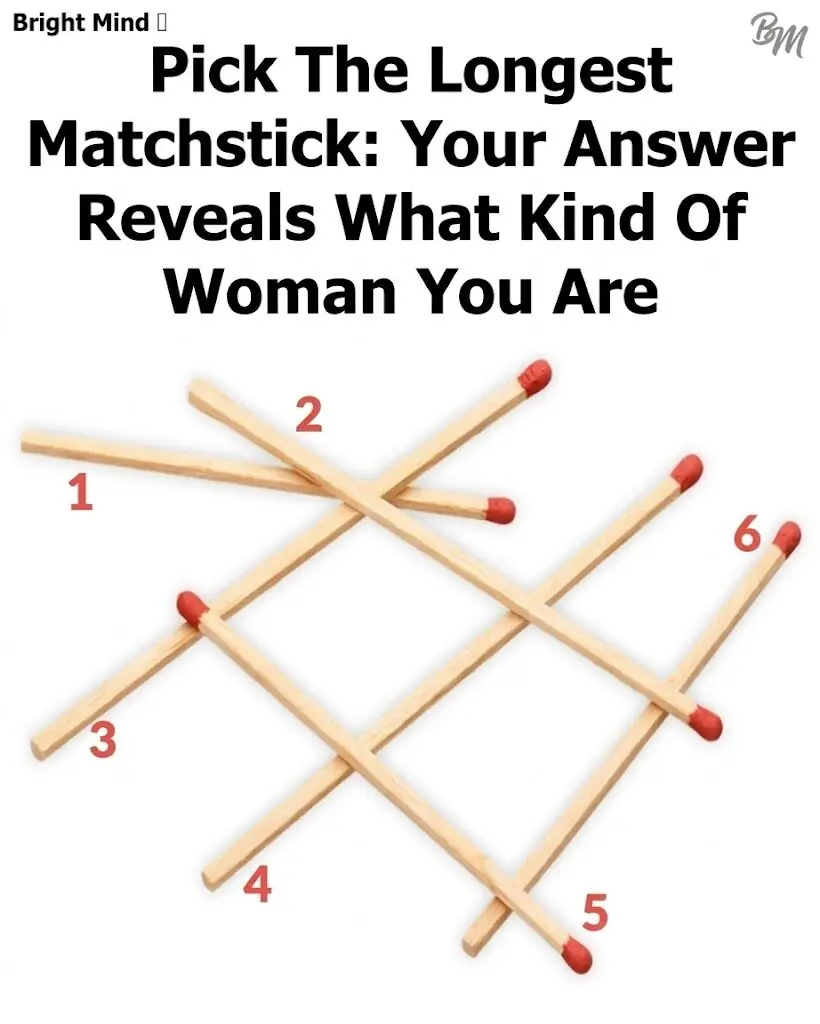
Pick the Longest Matchstick 🔥 Your Choice Reveals Your Personality 1
Facts 13/04/2026 17:26

The Viral “How Many Squares” Puzzle That Has Everyone Debating
A simple illustration of overlapping squares has unexpectedly taken over social media — not because it’s complicated, but because no one can seem to agree on how many squares are actually in the picture. What looks like an ordinary geometric sketch turns into a surprisingly tricky visual riddle. People stare at it longer than expected, spot new shapes they missed before, and sometimes swear the total changes depending on where they focus.
The result? Comment sections full of friendly arguments, jokes, and theories about what the number you see might “say” about you.
Of course, the whole personality-analysis angle is just playful internet fun — there’s nothing scientific behind it. What is interesting, though, is how differently people interpret the same image. At first glance, most viewers immediately recognize the nine small squares that form the basic grid. After a moment of closer inspection, four medium-sized squares emerge, each created by combining smaller ones. Finally, there’s the large outer square that frames the entire design.
Put them all together, and the full image contains fourteen squares — though not everyone spots them on the first try.
What’s made the puzzle go viral isn’t just the final answer, but the process of getting there. Depending on how your eyes naturally scan the pattern, you may see only the smallest shapes at first, or jump straight to the largest. Some people focus on individual units, others on combinations, and many switch back and forth, discovering new shapes as they go.
This variety in perception has led to an explosion of lighthearted categories online. People who count only a few squares are jokingly described as relaxed and easygoing. Those who find a middle number are said to have balanced attention. And the rare viewers who immediately spot all fourteen are playfully labeled as hyper-observant. None of this is meant seriously, of course — but it adds charm and humor to the shared challenge.
Ultimately, the viral image works because it offers a moment of simple reflection. It invites us to consider how we approach visual tasks:
Instead of diagnosing personality traits, this little puzzle encourages mindfulness and curiosity. It shows how a slight shift in focus can reveal more than we initially see — a gentle reminder that perspective matters.
In a digital world packed with fast, disposable content, this small square puzzle stands out. It’s a pause, a breather, a playful mental reset that turns a basic drawing into something unexpectedly engaging.
Sometimes the simplest images spark the best conversations.