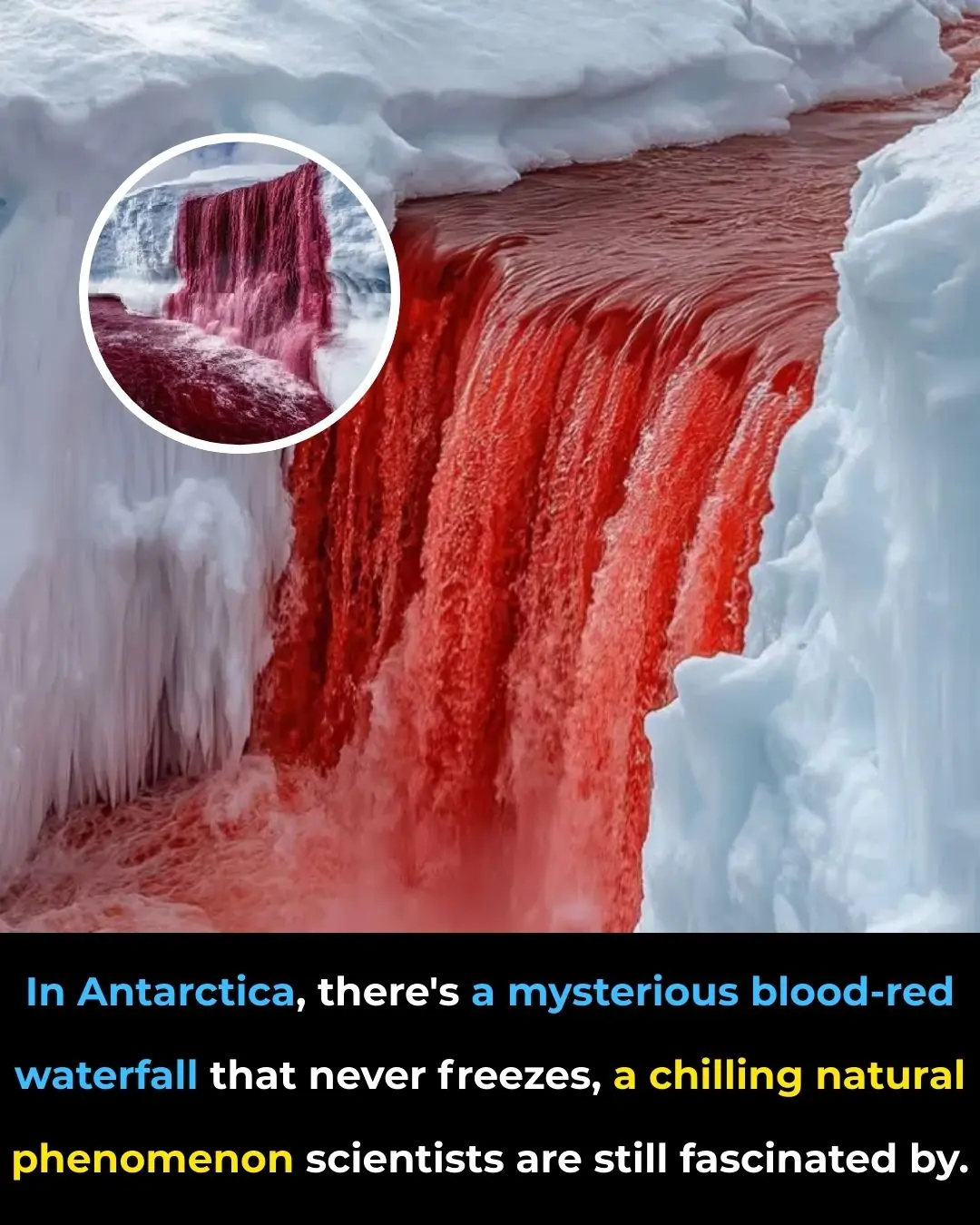
In Antarctica, there exists a captivating natural phenomenon known as Blood Falls, a waterfall that flows with a vivid red hue and remains unfrozen despite the frigid conditions surrounding it. First discovered in 1911 by Australian geologist Thomas Griffith Taylor during the Terra Nova Expedition, Blood Falls has since fascinated scientists and explorers alike with its mysterious appearance and behavior. According to All That’s Interesting, when Taylor first encountered the waterfall, scientists speculated that the peculiar red color was caused by algae. However, more recent studies have uncovered a much more intriguing explanation: the water is rich in iron, and it is the oxidation of this iron that gives the waterfall its distinct blood-like appearance.
The water that creates Blood Falls originates from a hypersaline subglacial pool, situated beneath approximately 400 meters of ice. This saline pool, as reported by Live Science, contains a high concentration of dissolved salts, which significantly lowers the freezing point of the water. As a result, even in the midst of Antarctica’s extreme cold, the water remains in a liquid state, continuously flowing and creating the dramatic visual effect that has earned Blood Falls its name. This process of freezing point depression explains why the waterfall does not freeze, despite the surrounding ice and sub-zero temperatures.
The composition of the water in Blood Falls is fascinating in itself. The high iron content, when exposed to the oxygen in the atmosphere, undergoes a process called oxidation. This chemical reaction turns the water bright red, producing a striking and surreal visual contrast against the stark white ice and snow surrounding it. The phenomenon serves as a reminder of the harsh and unpredictable nature of Earth's most extreme environments, where even the most extreme cold cannot prevent such unusual and striking occurrences.
Interestingly, Blood Falls is not the only place in Antarctica where such phenomena occur. Other subglacial lakes and water sources in the region are also known to contain similar chemical compositions, though Blood Falls is by far the most well-known. The discovery of this unique natural feature has contributed to our understanding of the processes at play beneath the Antarctic ice, revealing insights into both the chemistry of the region and the resilience of life in extreme conditions.
The existence of Blood Falls challenges our conventional understanding of life and its ability to thrive in seemingly inhospitable environments. Microorganisms have been discovered living in the briny water of the subglacial pool, surviving despite the extreme conditions, providing valuable insights into how life might endure in other extreme environments, including those found on other planets or moons in our solar system. For example, scientists have drawn parallels between the subglacial ecosystems in Antarctica and potential habitats on icy moons like Europa, one of Jupiter’s moons, which is believed to harbor an ocean beneath its icy crust.
Blood Falls continues to intrigue scientists and explorers, offering a window into the extreme and often hidden environments of our planet. It stands as one of the most unusual and visually striking features of Antarctica, a region known for its harsh conditions and stark beauty. The ongoing research into the phenomenon promises to deepen our understanding of both Earth's extreme environments and the fundamental processes that govern life on our planet.
Sources:
-
All That’s Interesting. "Blood Falls: The Red Waterfall of Antarctica." [Link to source].
-
Live Science. "Why Does Blood Falls in Antarctica Flow Red?" [Link to source].