
They took one look and said, "You got lucky." That's when I reali...
Facts 21/05/2026 21:32
The Rapid Movement of Earth's Magnetic North Pole: A Critical Phenomenon for Navigation and Science
The magnetic North Pole is undergoing an unprecedented and well-documented shift, a phenomenon that has piqued the interest of the scientific community, geophysicists, and navigational experts worldwide. This rapid movement is not just a minor curiosity—it holds significant implications for both scientific research and modern navigation systems.
At the core of this movement lies the planet’s liquid iron outer core, which drives complex convection currents. These currents create Earth's magnetic field, and the magnetic North Pole's location is not fixed; instead, it continuously changes over time in a process known as secular variation. While the magnetic field is relatively stable on a long-term scale, short-term shifts in the magnetic pole’s position are quite common, and these shifts have become more pronounced in recent decades.
Historically, the movement of the magnetic North Pole was a gradual process. However, starting in the late 20th century and accelerating into the 21st century, this movement has significantly intensified. What once occurred at a rate of about 10 kilometers per year has now increased to approximately 50 to 60 kilometers per year. This rapid shift is significant because it represents a dramatic change in a process that has been occurring naturally for millions of years.
The magnetic North Pole’s migration is particularly noticeable since the early 1990s, with the pole now heading toward Siberia. This shift has seen the pole moving away from its traditional location in the Canadian Arctic and across the International Date Line, continuing its movement over the Arctic Ocean. As a result, the pole’s trajectory now points toward Siberia, marking a new chapter in the ongoing dynamic changes of Earth’s magnetic field.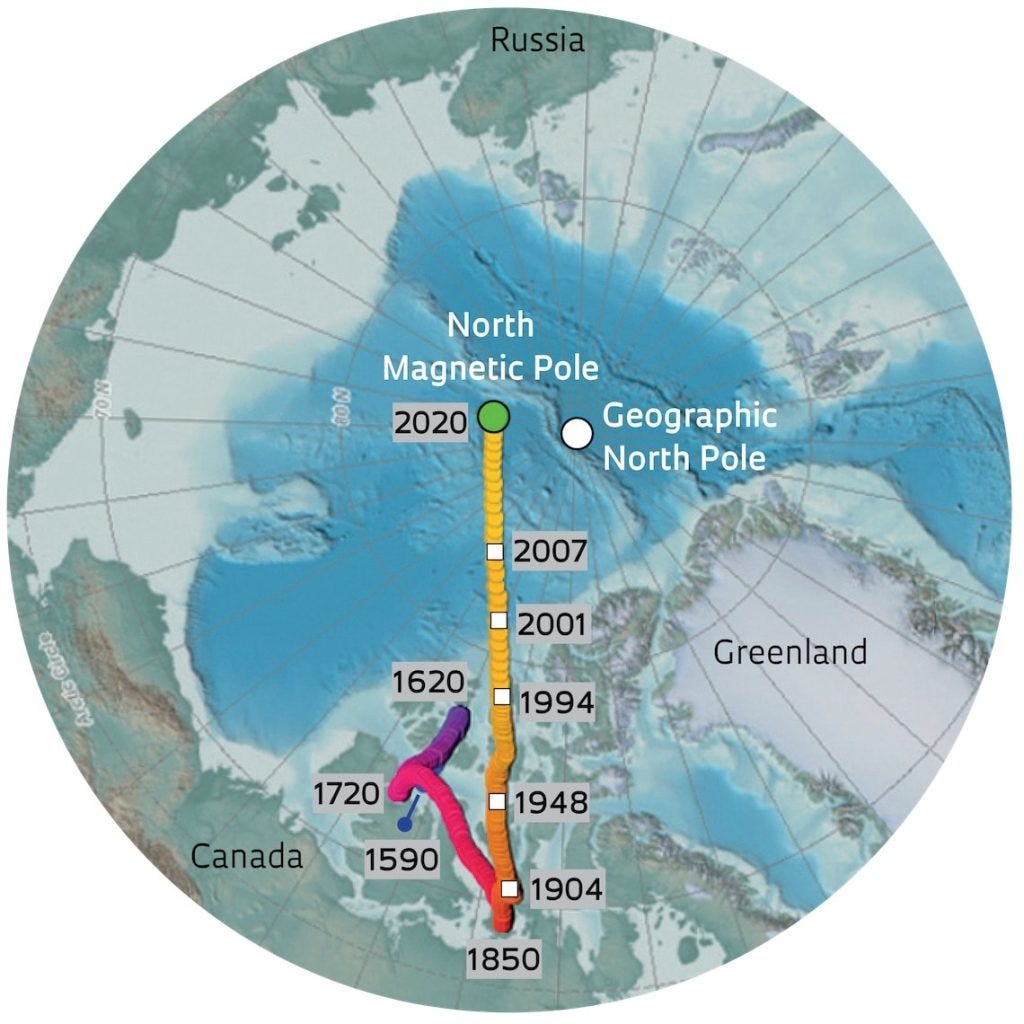
The rapid pace of this drift is more than a scientific curiosity; it has important practical consequences, especially for navigation systems. The World Magnetic Model (WMM), which is the standard model of Earth's magnetic field, is used worldwide for a wide range of applications, from military defense systems to commercial technologies. The WMM is vital for ensuring the accuracy of compasses, GPS systems, and other navigation tools. For example, the U.S. Department of Defense, NATO, and the United Kingdom’s Ministry of Defence rely on the WMM for precise navigation in both civilian and military operations. In addition, commercial applications, such as smartphones, also depend on this model to provide accurate directional data for GPS systems and digital compasses.
Given the pole's increased velocity, navigational systems dependent on the WMM have had to be adjusted more frequently. This is because the magnetic field is moving away from its previous reference points, and these shifts must be accounted for in the calculations of modern navigation systems. The WMM is updated every five years, but the accelerating pace of the magnetic pole's movement means that updates may need to occur more regularly to maintain accuracy.
The shifting of the magnetic North Pole also raises important scientific questions about the Earth's core and its behavior. Researchers are working to better understand the underlying causes of the rapid migration and the role of deep-earth convection currents in this process. These currents, which are driven by heat from the Earth's interior, are responsible for the movement of molten iron and other materials in the outer core. The interaction of these materials generates the Earth's magnetic field and affects the location of the magnetic poles.
As the magnetic pole continues its journey toward Siberia, it is essential for both scientists and navigation experts to monitor its movement closely. Understanding the exact nature of this shift could lead to greater insights into Earth’s magnetic dynamics and improve the predictability of future changes. Additionally, scientists are exploring whether this shift in the magnetic field could indicate larger changes within the Earth's core, such as a potential reversal of the magnetic poles, although such events typically occur on time scales of tens of thousands of years.
The impact of this rapid shift on global navigation systems and scientific understanding cannot be understated. The increasing rate of change in the magnetic North Pole's position is a testament to the dynamic nature of the planet and the complexity of Earth's core processes. As technology continues to advance, it is vital that we remain aware of these changes and update our systems to ensure the continued accuracy of navigation tools that millions of people rely on every day.
National Oceanic and Atmospheric Administration (NOAA) – Magnetic Field Changes and Their Implications. Link
British Geological Survey – Understanding Earth's Magnetic Field. Link
United States Geological Survey (USGS) – Magnetic North Pole Movement. Link
World Magnetic Model (WMM) – About the WMM and Its Updates. Link