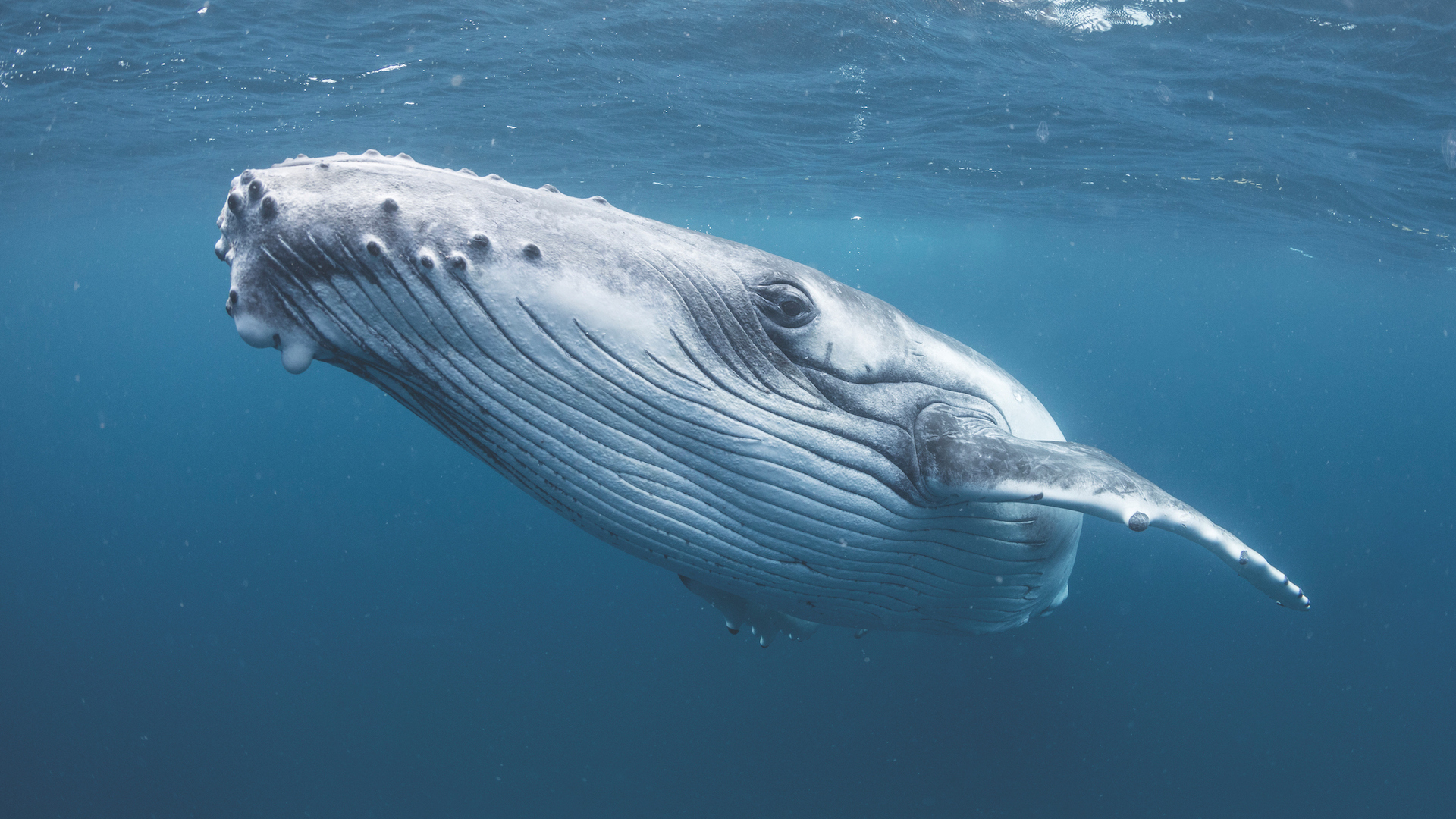
A male humpback whale has stunned scientists after completing an extraordinary journey of 8,106 miles (13,046 kilometers), traveling from the Pacific Ocean to the Indian Ocean and potentially interacting — and mating — with multiple whale populations along the way.
According to a new study, the whale crossed at least three oceans in what researchers believe was a long-distance search for breeding opportunities. This remarkable voyage represents the longest great-circle distance ever recorded between two confirmed sightings of a humpback whale (Megaptera novaeangliae). A great-circle distance measures the shortest possible path between two points on Earth’s curved surface, highlighting just how exceptional this migration truly was.
The whale was first documented off the coast of Colombia in the eastern Pacific Ocean and later spotted near Zanzibar in the southwest Indian Ocean. Researchers estimate that the whale likely traveled eastward from Colombia, aided by prevailing currents in the Southern Ocean. Along this route, it may have passed through or briefly joined humpback whale populations in the Atlantic Ocean, suggesting an unprecedented level of connectivity between groups previously thought to be largely separate.
“This was a very exciting find — our initial reaction was that there had to be some mistake,” said Ted Cheeseman, a doctoral student at Southern Cross University in Australia and director of Happywhale, a global image database used in the study. Cheeseman noted that beyond the sheer distance traveled, one of the most significant discoveries was the whale’s interaction with multiple breeding populations, demonstrating a far greater range of movement than scientists had ever documented before.
Traditionally, humpback whales are known for highly consistent migration routes. They typically move north to south each year, traveling between cold, food-rich polar waters and warmer tropical breeding grounds. While humpbacks can swim more than 5,000 miles (8,000 km) annually, they rarely travel long distances east to west and generally do not mix extensively with other populations.
This newly observed transoceanic journey challenges those long-held assumptions. Although rare long-distance migrations have been recorded in the past — such as a female humpback that swam 6,100 miles (9,800 km) from Brazil to Madagascar between 1999 and 2001 — the male in this study surpassed all known records by moving from one breeding region to another across multiple ocean basins.
The identification of the whale was made possible through photographs collected between 2013 and 2022 and later uploaded to Happywhale. The images confirmed sightings of the same sexually mature male in two locations off Colombia and, five years later, in the Zanzibar Channel. In each instance, the whale was observed within a competitive group — a social structure where several males compete for access to a single female guarded by a dominant “principal escort.”
Study lead author Ekaterina Kalashnikova, a biologist with the Tanzania Cetaceans Program and the Bazaruto Center for Scientific Studies in Mozambique, emphasized the broader implications of the findings. “We’ve been able to document novel behavior that provides valuable insight into humpback whale ecology and social dynamics,” she said.
Researchers believe the primary motivation for the whale’s epic journey was reproductive opportunity, as mating with individuals from different populations could increase genetic diversity. However, other factors may also have played a role, including climate-driven changes in ocean conditions, shifts in food availability, and growing humpback whale populations that intensify competition among males during breeding seasons.
The study was published on Tuesday, December 10, in the journal Royal Society Open Science, offering new evidence that humpback whale migrations are far more flexible and complex than previously understood.