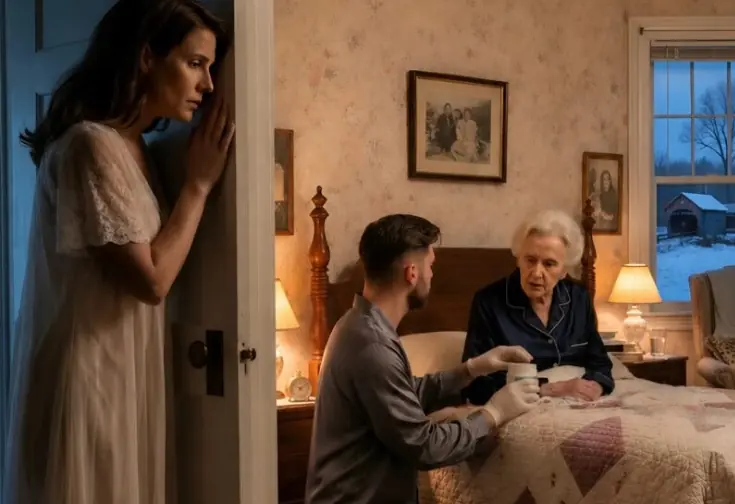
Every night, my husband...
Life stories 11/05/2026 17:31
The city doesn’t care about you. That’s the agreement you make when you move into one — you get the anonymity, the motion, the sensation of being part of something enormous, and in exchange the city takes your name. Rush hour is the purest expression of this. Ten thousand people moving at full speed in the same corridor of time, not one of them seeing the others. Just coats and phones and the white noise of shared urgency going nowhere in particular.
She was in it. He was in it. Same street, different directions, the same 8:47 AM swallowing them both.
Then her phone lit up.
Then his.
Same second. She would check later — to the exact second. 8:47:23.
The message was four words: I need you. Please come.
She stopped walking. The city flowed around her like water around a stone.
He stopped too, half a block away, and the same four words were doing the same thing to his chest — pressing on something it had no right to press on, from a number he didn’t recognize, from a child whose contact name in his phone was a question mark because he hadn’t known what else to call her when she’d first reached out three weeks ago, tentative and extraordinary, with a voice note that had made him sit down on his kitchen floor and not get up for an hour.
She was already moving. Her feet decided before she did.
He was already moving. Same direction.
They rounded the same corner.
— — —
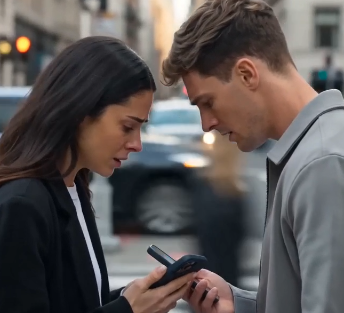
The collision was fast and graceless and very human. Phones flying. Someone’s coffee cup hitting the pavement. A moment of pure chaos — arms, apologies, the automatic social choreography of two strangers bouncing off each other in a city that produces this exact event approximately four hundred times a day.
Then the phones landed.
Screen-up. Side by side on the wet pavement. Like they’d been placed there.
Same message on both screens. Same four words. Visible to both of them at once.
They looked down at the same moment. The way people do when something speaks louder than embarrassment.
— — —
Both reached for their own phone. Grabbed the wrong one.
She was already reading his screen when she realized the case was wrong. He was already seeing her wallpaper when he realized the weight was different.
Same wallpaper.
A child’s face. Seven years old, gap-toothed, laughing at something off-camera with her whole body the way only children laugh, completely unself-conscious, completely present.
The same child.
His daughter.
Her daughter.
The world didn’t stop. The city kept moving — ten thousand people still late for ten thousand things. But inside the radius of two feet of pavement, something very large and very quiet happened.
Her voice came out barely above breath. “That’s my daughter.”
His voice came from somewhere lower. “That’s my daughter.”
— — —
They looked up slowly.
Really looked. The kind of looking you don’t do with strangers, the kind that takes more than a glance, the kind that reads instead of just sees.
It hit her first. A hospital. Seven years ago. A waiting room at 2:00 AM — she’d been there for something minor, a scare that turned out to be nothing, and she’d met a man in the corridor and they’d talked for three hours the way you only talk to strangers you’ll never see again, honest and strange and somehow safe. She’d given him a fake number in the morning because she was afraid of how not-strange it felt. She’d regretted it since. Vaguely. The way you regret things you can’t name.
She hadn’t known she was pregnant yet.
She hadn’t known.
His jaw worked. She could see him getting there — the same memory, from his side of the corridor, his version of those three hours, the number that hadn’t worked, the woman he’d looked for exactly once and then told himself to stop.
Seven years.
Her hand was trembling when she pulled up the photo on his phone. Their daughter. Smiling at the camera with the particular smug satisfaction of a child who has just done something very clever.
She’d sent it to both of them.
“She found us both,” she said. Her voice broke on the last word. Not all the way. Just enough to let the seven years out a little.
— — —
His phone buzzed again.
A voice note. Twelve seconds long. From the contact in his phone still named with a question mark, though he’d been meaning to change it, though every time he opened the contact he didn’t know what to type because father felt too large and too unearned and he wasn’t sure yet what he was allowed to call himself.
They leaned in together — heads almost touching, the way you lean toward a sound you need to hear correctly — and pressed play.
The city noise dropped away. Or maybe it didn’t. Maybe they just stopped being able to hear it.
A small voice filled the space between them.
“Mom… I found him. Are you together yet?”
— — —
He reached for her hand without thinking. The way you reach for something in the dark — not because you decided to, but because your body is smarter than the part of you that deliberates.
She didn’t pull away.
Both phones lit up again. Same message. This time with a single emoji they would both, separately, sit with for years.
“I knew you’d find each other. ”
She was seven years old.
And she understood something they had spent years running from — that the people we come from leave fingerprints on us, and eventually those fingerprints are enough for someone small and determined and entirely without fear to follow all the way back to the beginning.
She had done the thing adults are too complicated to do.
She had simply looked for what was missing.
And she had found it.
Read the continuation in the comments.