
The reasons behind children not visiting their parents
Facts 03/05/2026 14:56
The Andromeda Galaxy, also known as M31, is the closest major galaxy to our Milky Way and the largest member of the Local Group of galaxies. Although it lies an astonishing 2.5 million light-years from Earth, Andromeda is so bright and massive that you can actually spot it with the naked eye on a dark, clear night — making it the most distant object the average person can see without a telescope.
Astronomers from NASA, ESA, and the Harvard–Smithsonian Center for Astrophysics have studied Andromeda for decades, revealing new insights about its enormous size, powerful gravitational influence, and long-term relationship with our own galaxy. What appears as a faint blur in the sky is, in reality, a sprawling star city far larger than anything in our cosmic neighborhood.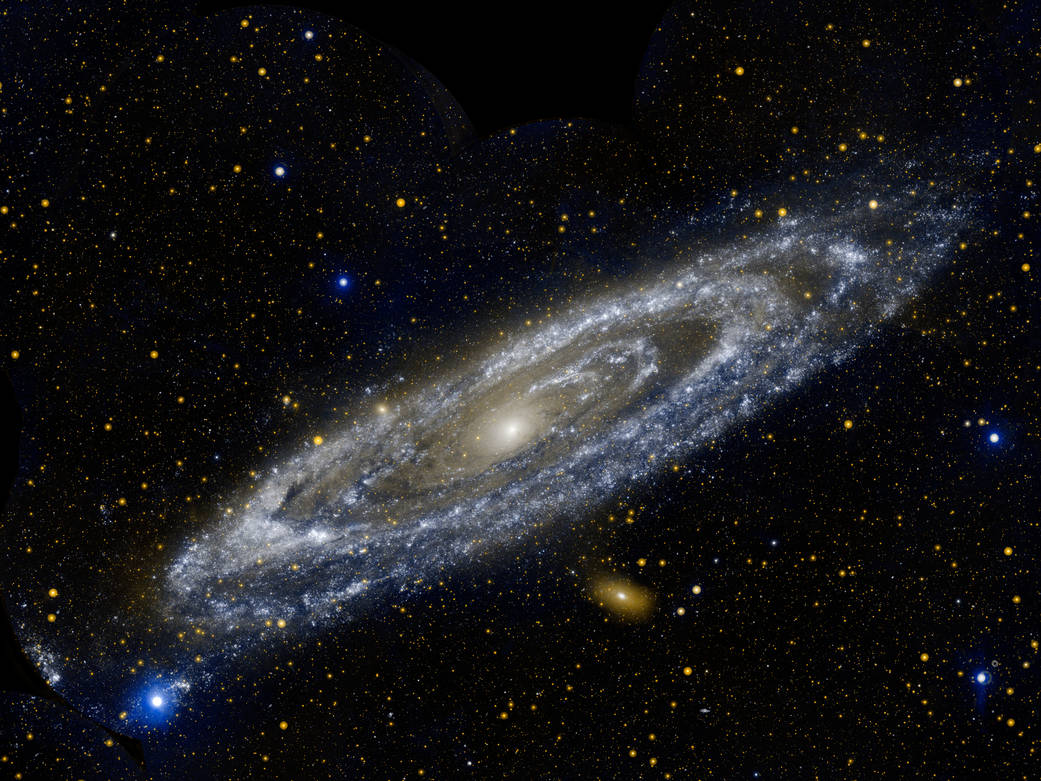
Andromeda contains over 1 trillion stars, significantly more than the estimated 200–400 billion stars in the Milky Way. This incredible stellar population makes it one of the largest spiral galaxies in the nearby universe. Observations from the Hubble Space Telescope confirm that Andromeda’s spiral arms are filled with bright, young stars and vast nebulae where new stars are continually forming.
Andromeda is not drifting away like most galaxies; instead, it is racing toward the Milky Way at around 110 km/s — roughly 400,000 km/h. According to NASA and ESA’s Gaia mission, this motion is caused by the mutual gravitational pull between the two giant galaxies.
In about 4.5 billion years, the Milky Way and Andromeda will collide and eventually merge. Astronomers call the result “Milkdromeda”, a single massive elliptical or lenticular galaxy. Computer simulations from NASA and the Space Telescope Science Institute show that although the galaxies will merge, most stars will pass through the collision unharmed due to the vast distances between them.
Andromeda hosts several giant star-forming regions, including NGC 206, one of the brightest young stellar associations nearby. It is also rich in globular clusters, some of which are older than 10 billion years. This makes Andromeda a key object for studying the early history of galaxies and star formation.
At its center, Andromeda contains a supermassive black hole estimated to be tens of millions of times the mass of the Sun. Observations reported by NASA and the Chandra X-ray Observatory show energetic emissions from this core region, confirming intense gravitational activity.
Even though it appears close in the night sky, the light you see from Andromeda began its journey 2.5 million years ago — long before modern humans existed. When you look at Andromeda, you are seeing it as it was during the early evolution of humanity’s distant ancestors.
The next time you step outside on a clear night and notice a small, hazy smudge in the constellation Andromeda, remember what you are truly looking at: a colossal spiral galaxy hurtling through space, filled with more than a trillion stars, and destined one day to merge with our own Milky Way.
Andromeda isn’t just our nearest major galactic neighbor —
it’s a glimpse into the future of our entire cosmic home. 🌠