🎬 PART 2: “Why the Anklet Changed Everything”
Life stories 29/04/2026 23:05
The cafeteria was always the loudest place in Westbrook Middle School.
Trays slammed onto tables. Sneakers squeaked across the floor. Kids shouted over each other, trading fries, laughing at jokes, recording TikToks they were not supposed to film during lunch.
But on that Friday afternoon, the loudest table was not laughing because something was funny.
They were laughing at Ethan Cole.
Ethan was ten years old, small for his age, with thin arms, oversized glasses, and a backpack that looked too heavy for his narrow shoulders. He sat alone near the far wall, where the sunlight from the high windows cut across the floor in pale squares.
He had learned to sit there because it was the closest table to the cafeteria exit.
Just in case.
For months, Ethan had tried to become invisible.
He kept his head down. He never raised his hand in class. He never corrected anyone when they mispronounced his last name. He smiled when teachers asked if everything was okay, because saying no had only made things worse before.
The boys who picked on him called themselves “The Kings.”
There were four of them, all older, louder, and bigger than him. Their leader, Tyler Banks, was twelve and already acted like the hallway belonged to him. His father owned half the car dealerships in town, and Tyler carried that fact like a weapon.
That day, Ethan had only wanted to eat.
His lunch was simple: noodles in a plastic container, an apple, and a small note tucked under the napkin.
You’re braver than you think. — Mom
He had read the note twice before folding it carefully and sliding it into his pocket.
Then the shadow fell across his tray.
“Well, look who’s eating alone again,” Tyler said.
Ethan froze.
The other three boys surrounded the table. A few nearby students noticed. One girl whispered, “Not again.” But no one stood up.
Tyler picked up Ethan’s apple, looked at it like it offended him, and tossed it to another boy.
“Please,” Ethan said quietly. “Just leave me alone.”
That made them laugh harder.
One of the boys shoved Ethan’s shoulder. His knee hit the table. His milk carton tipped over, spilling white across the tray.
Phones came out.
At first, only two students were recording. Then five. Then more.
Because that was what kids did now.
They did not stop cruelty.
They saved it.
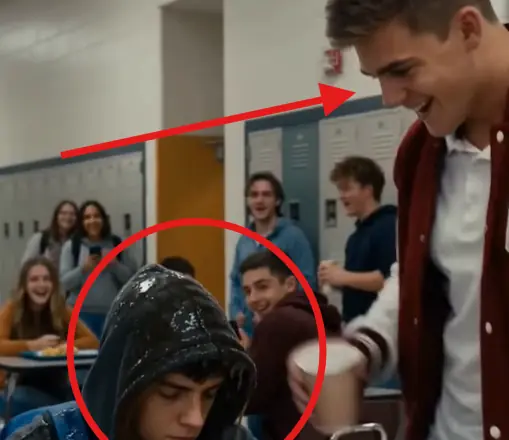
Tyler grabbed Ethan’s noodles and lifted the container above his head.
Ethan looked up, terrified.
“Don’t,” he whispered.
Tyler smiled.
Then he turned toward the phones and raised his voice.
“Let this be a lesson to you.”
The noodles poured down over Ethan’s hair, glasses, shirt, and face. Warm sauce slid onto his cheeks like tears.
The cafeteria exploded with laughter.
Ethan did not move.
He just sat there, covered in food, trying so hard not to cry that his chin began to shake.
Someone shouted, “Post it!”
Another kid laughed, “He’s going viral!”
And then—
BANG.
The cafeteria doors slammed open.
The sound was so sudden that every head turned.
A group of bikers stood in the doorway.
There were six of them, all in black leather jackets, heavy boots, and road-worn jeans. Their faces were hard, sunburned, bearded, and serious. They looked completely out of place beneath the fluorescent school lights.
For one breath, nobody moved.
Then the lead biker stepped forward.
He was tall, broad-shouldered, with gray in his beard and eyes that carried the weight of someone who had seen too much. His jacket had a patch on the chest that read:
IRON SAINTS
The cafeteria fell silent.
Even Tyler stopped smiling.
The biker walked slowly between the tables, his boots echoing on the floor. The other bikers followed behind him, not rushing, not shouting, not threatening.
Just watching.
The students lowered their phones.
The lead biker stopped beside Ethan.
For the first time all year, someone looked at the boy not with pity, not with annoyance, not with curiosity—
but with pain.
The biker crouched down.
“Son…” he said, his voice rough but gentle. “Who hurt you?”
Ethan stared at him through sauce-covered glasses.
His lips parted, but no sound came out.
Tyler suddenly stepped back.
“It was just a joke,” he said quickly. “We didn’t mean anything.”
The biker did not even look at him.
He took a napkin from the table and carefully wiped sauce from Ethan’s face.
“Jokes don’t make kids shake like this,” he said.
A teacher finally rushed into the cafeteria, followed by the principal, Mr. Harris.
“What is going on here?” the principal demanded.
Tyler immediately pointed at the bikers.
“They came in here threatening us!”
But the lead biker stood slowly and reached into his jacket.
For a moment, everyone stiffened.
Then he pulled out a badge.
The cafeteria gasped.
“My name is Detective Raymond Cole,” he said. “And this boy is my son.”
Tyler’s face went pale.
Ethan looked up in shock.
“Dad?” he whispered.
Detective Cole’s expression changed.
It was small, almost invisible, but Ethan saw it. The anger cracked, and underneath it was something broken.
“I’m sorry I’m late,” his father said.
Ethan had not seen him in three months.
His mother had told him Dad was working undercover on something dangerous. Ethan had believed her, but some nights he wondered if his father had simply forgotten him.
Now he understood.
The leather jacket. The bikers. The rough faces.
They were not a gang.
They were undercover officers.
The principal swallowed hard.
“Detective Cole… I didn’t know—”
“No,” Cole said coldly. “You didn’t know because you never looked.”
Then he turned toward the students.
“Everyone who recorded this, keep your phones exactly where they are.”
A few kids looked scared.
Cole nodded to one of the bikers, a woman with short black hair and a scar above her eyebrow. She stepped forward and held up her own phone.
“We recorded everything too,” she said.
Tyler’s eyes widened.
Detective Cole finally turned to him.
“For months, my son has come home with bruises. Torn notebooks. Missing lunch money. And every time, this school told us there was no proof.”
Tyler opened his mouth, but nothing came out.
Cole looked around the cafeteria.
“Today, you gave us proof.”
The silence became heavier than the laughter had been.
Tyler’s friends backed away from him like cruelty was suddenly contagious.
The principal tried to speak again.
“Detective, perhaps we can discuss this privately—”
“No,” Cole said. “You handled it privately for months. That ends today.”
Ethan stood slowly, noodles sliding from his shirt onto the floor. His hands trembled.
His father put one hand on his shoulder.
And for the first time in a long time, Ethan did not feel small.
But then the real shock came.
Tyler suddenly started crying.
“My dad is going to kill me,” he whispered.
Detective Cole looked at him carefully.
Something in the boy’s fear was different now.
Not fear of punishment.
Fear of going home.
Cole’s anger faded just enough for him to notice.
“What did you say?” he asked.
Tyler wiped his face fast. “Nothing.”
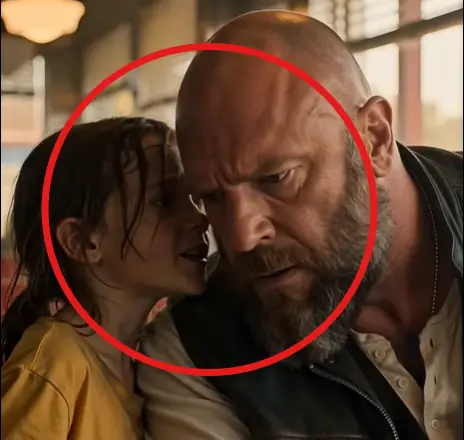
But Ethan, still shaking, looked at his father and whispered, “He has bruises too.”
Everyone turned.
Tyler froze.
Ethan pointed toward Tyler’s wrist, where his sleeve had pulled up during the bullying. A dark mark showed beneath the cuff.
Detective Cole’s eyes narrowed.
The cafeteria went completely still.
Tyler tried to hide his arm, but it was too late.
Cole took one step toward him.
“Tyler,” he said, softer now, “who hurt you?”
The boy who had poured noodles over Ethan’s head stared at the floor.
His lips trembled.
For the first time, Tyler Banks looked exactly like what he was.
A child.
And then he whispered the answer.
“My father.”
No one laughed now.
No one recorded.
No one moved.
Detective Cole looked at Ethan, then at Tyler, then at the silent school around them.
The case he had come to close was suddenly bigger than bullying.
Much bigger.
Because by the end of that day, the videos from the cafeteria would expose one cruel lunchroom…
but Tyler’s confession would expose half the town.
And years later, when people asked Ethan why he forgave the boy who humiliated him in front of everyone, he would simply say:
“Because that was the day I learned hurt people don’t always look hurt.”
And Tyler?
He never became Ethan’s best friend.
Stories do not always end that neatly.
But one year later, on Ethan’s first day of sixth grade, someone sat beside him in the cafeteria.
Tyler placed an apple on Ethan’s tray.
He did not say sorry.
Not at first.
He just sat there quietly, hands folded, eyes lowered.
Then he whispered, “Can I sit here?”
Ethan looked at him for a long moment.
Then he moved his backpack off the chair.
And for the first time, the table near the exit did not feel like a hiding place.
It felt like a beginning.