What Is That Fabric Strip Across Hotel Beds? The Surprising Purpose Explained
Tips 16/04/2026 09:35
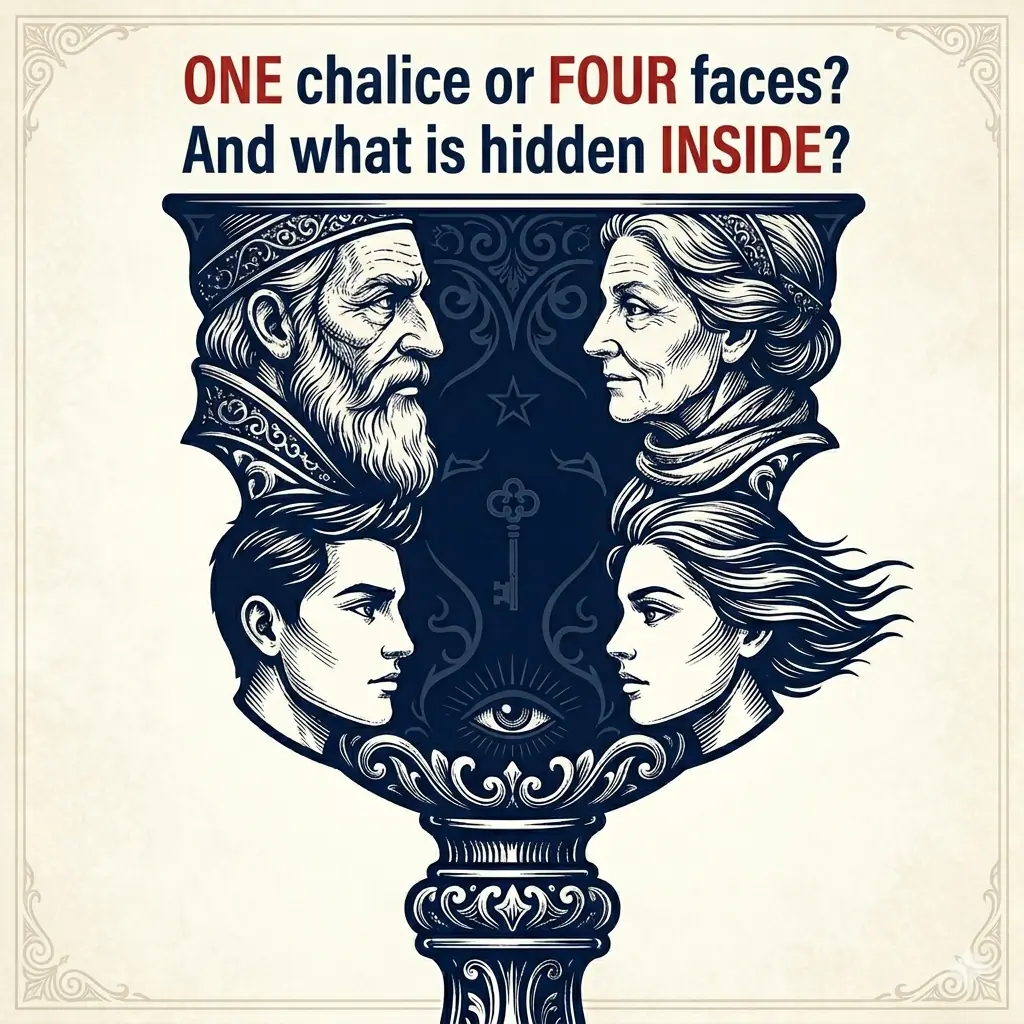
Optical illusions are more than just "tricks" for the eyes; they are windows into how our brains process reality. This specific artwork, featuring a grand chalice formed by the profiles of four people, is a sophisticated evolution of the famous Rubin Vase.
At first glance, your brain must choose what to prioritize. This is known in psychology as Gestalt Theory.
The Four Faces: On the left, we see an elderly man and a young man; on the right, an elderly woman and a young woman. Their silhouettes are meticulously carved to create the curves of a cup.
The One Chalice: When you ignore the details of the faces and look at the negative space (the dark center), a decorative goblet or "chalice" emerges.
The "struggle" you feel as your eyes jump back and forth is called bi-stable (or multi-stable) perception. The brain cannot see both the faces and the chalice as the primary object at the exact same millisecond, so it toggles between them.
The text in the image asks: "And what is hidden INSIDE?" While the faces and the chalice are the obvious elements, there are three cryptic symbols hidden in the dark negative space of the cup’s center:
The Star: Located at the very top, symbolizing guidance, divinity, or higher consciousness.
The Key: Hanging in the center, representing a "solution," a secret, or the opening of a locked door.
The All-Seeing Eye: Positioned at the base of the cup, a common symbol for wisdom, providence, or spiritual awakening.
This isn't just a random drawing. The choice of characters suggests a thematic depth:
Youth and Age: By placing a young man/woman below an older man/woman, the image represents the passage of time and the cycle of life.
The Chalice as a Metaphor: In many cultures, a chalice represents the "vessel of life" or the "mind." The fact that it is built from human faces suggests that our experiences, our ancestors, and our growth are what "contain" our soul.
Research shows that humans are evolutionarily hardwired to recognize faces first (a phenomenon called pareidolia). However, when those faces are turned sideways and silhouetted, it confuses the "Object Recognition" part of the temporal lobe.
When you finally see the Star, Key, and Eye, it triggers a small "aha!" moment—a dopamine hit that occurs when the brain successfully solves a visual pattern.